 RuAviation
Russia Begins Assembly Of Meridian Uncrewed Amphibious Transport Aircraft
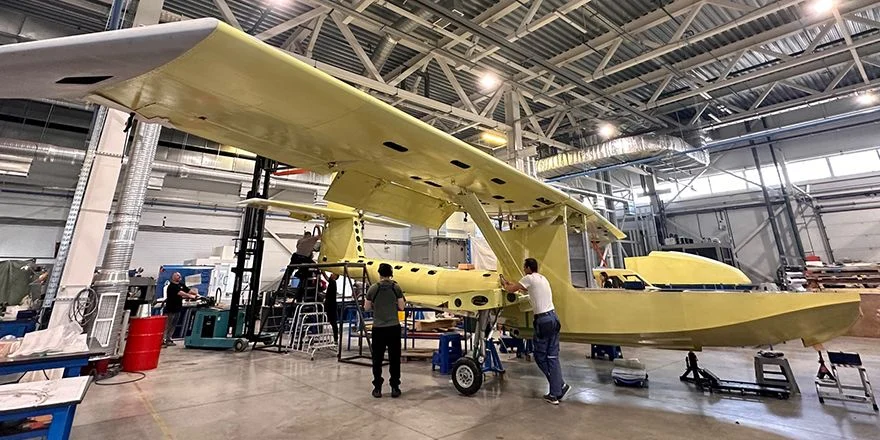
Russia’s Centre for Autonomous Robotic Systems (TsARS) has begun assembling the first flight-test prototype of the Meridian uncrewed amphibious transport aircraft, a platform designed to deliver cargo to remote areas with limited access to conventional transport infrastructure.
The aircraft is being developed for operations from paved and unprepared runways as well as water surfaces. This combination is intended to support regional logistics in areas where seasonal conditions, poor road networks or a lack of airfields restrict access by conventional transport aircraft.
Major airframe assemblies, including the centre wing section, outer wing panels and empennage, have been manufactured and joined. TsARS is now installing the flight-control system, with landing gear supports, the pilot’s cockpit and the fuselage among the remaining structural elements. The prototype will undergo ground-system checks and engine testing before its maiden flight.
The initial flight-test campaign will use a pilot-operated configuration, despite the aircraft’s intended uncrewed role. The prototype includes a cockpit for a test pilot, allowing the development team to assess handling characteristics and validate the aircraft’s flight performance before progressing towards fully autonomous operation.
Hydrodynamic testing has already been conducted using a dynamically scaled model. The programme examined water landings, impact behaviour and directional stability during surface movement. The results were consistent with earlier laboratory towing tests, providing experimental data on the aircraft’s water-handling characteristics ahead of full-scale assembly.
Meridian is a metal airframe design with a modular cargo arrangement. It is intended to carry payloads of up to 700 kg in a removable 5.5 m³ composite container made from glass fibre and carbon fibre. The modular configuration is intended to simplify cargo handling and support future integration of automated loading and unloading systems.
TsARS is also considering non-transport applications, including environmental monitoring and surveillance of land, water and ice surfaces. These missions would require additional optical equipment and further development of the aircraft’s autonomous control systems and ground-infrastructure interfaces.