 RuAviation
Soviet-Era D-30KU/KP Aero-Engines Sustain Industrial Power Generation in Russia
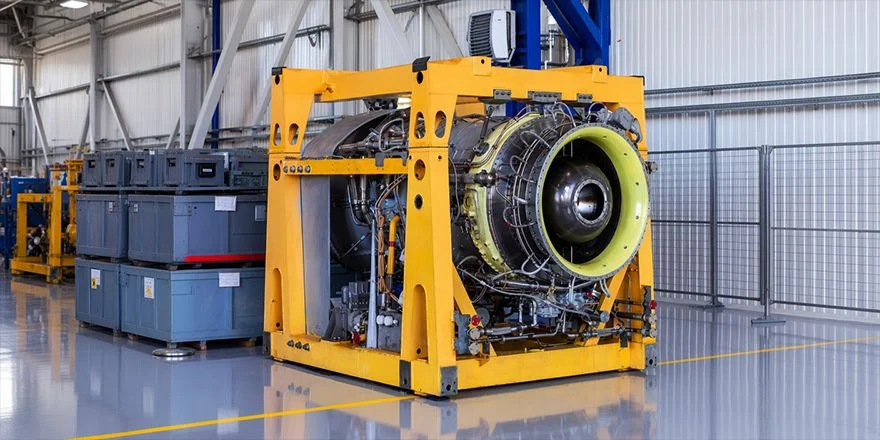
More than 120 gas turbines derived from the Soviet-era D-30KU/KP turbofan family are operating at Russian power plants, with the GТД-6/RM fleet recording more than 5 million operating hours. Developed by UEC-Saturn, the industrial derivatives demonstrate the long-term value of established aero-engine designs when adapted for stationary power generation.
The conversion programme has produced two industrial turbine types, the 6 MW GTD-6/RM and the 8 MW GTD-8/RM. Both draw on the two-shaft architecture of the D-30KU/KP, originally developed for the Ilyushin Il-62M, Tupolev Tu-154 and Il-76 aircraft. The industrial versions retain much of the original engine hardware while incorporating modifications for continuous operation in stationary installations.
According to United Engine Corporation (UEC), approximately 70% of the GTD-6/RM’s components are retained from the aviation design, while around 10% undergo modification and the remaining 20% are newly manufactured. This approach reduces the need for a completely new turbine development while adapting the engine to a substantially different operating environment.
The GTD-6/RM has been manufactured in Russia’s Yaroslavl Region since 2000. Unlike its aviation predecessor, which operates on aviation kerosene, the industrial turbine can use natural gas, associated petroleum gas or diesel fuel. This flexibility makes it suitable for industrial sites with different fuel supplies, particularly remote oil and gas production facilities.
The engine has an overhaul interval of 30,000 hours and a stated service life of up to 120,000 hours. Its gas turbine drives an electrical generator, while exhaust gases at temperatures of 500–530°C provide additional energy for combined heat and power generation. Recovered heat can be used to produce steam at pressures of 38–40 kgf/cm² and temperatures of up to 400°C, supporting further electricity generation through a steam turbine or supplying industrial processes and district heating networks.
One example is the Igolskaya-Talovaya GTES-12 power plant in Tomsk Region, which operates two 6 MW GTA-6/RM generating units. The facility supplies power to Tomskneft’s production infrastructure using associated petroleum gas. Its remote location, approximately 650 km from the nearest settlement, illustrates the role of autonomous gas-turbine generation where connection to centralised electricity networks is difficult or uneconomic.
The larger GTD-8/RM also supports industrial and municipal energy infrastructure. Turbines of this type operate at the 52 MW Tutaev combined-cycle thermal power plant in Yaroslavl Region, which supplies electricity to consumers including data centres and provides heat to the local district heating network. GTD-6/RM units are also deployed at power facilities in Saky, Crimea, and Naryan-Mar in the Nenets Autonomous Area.
The operational record of the GTD-6/RM fleet is significant in the context of industrial turbine development. More than 120 units are in service at Russian small and medium-sized thermal power plants, with cumulative operating time exceeding 5 million hours. The conversion of the D-30KU/KP into stationary power-generation equipment has therefore extended the commercial life of an established aero-engine architecture well beyond its original aviation applications.