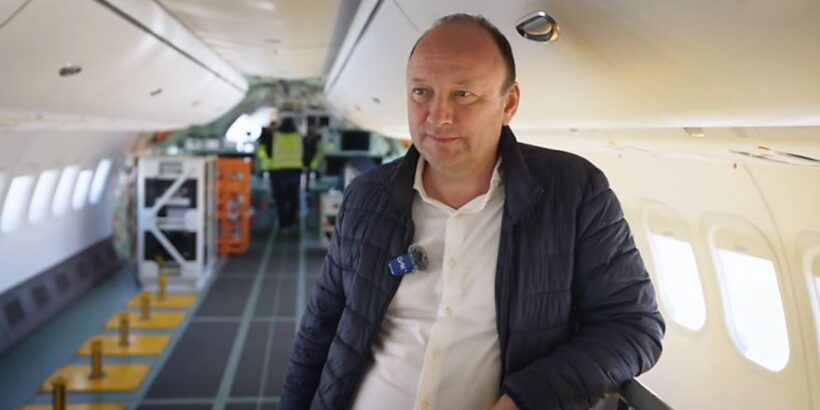
The MC-21-310 narrowbody programme is targeting its first customer deliveries in 2027, with eight aircraft due to enter Aeroflot’s fleet in the fourth quarter if the current schedule holds. The immediate priority for Yakovlev is to complete certification flight testing of the aircraft fitted with Russian-developed replacement systems before beginning series deliveries.
Anatoly Gaidansky, deputy managing director and head of Yakovlev’s engineering centre, described the programme as being in its final development phase. Flight-test aircraft are being used to evaluate the performance of substituted onboard systems and complete certification work. Serial production has started at the Irkutsk Aviation Plant, while suppliers manufacture airframe assemblies and equipment. Yakovlev aims to raise annual output capacity to 36 aircraft in the coming years.
The MC-21 is designed for up to 211 passengers. Its composite high-aspect-ratio wing, with an aspect ratio of 11.5, and relatively wide fuselage are intended to improve aerodynamic efficiency and cabin accommodation. The programme has also had to replace imported equipment across several major aircraft systems, a task accelerated by sanctions introduced in 2022.
Gaidansky identified electrical power generation and distribution, environmental control, engine starting, the auxiliary power unit and avionics among the most demanding areas of the substitution effort. The work has involved a supply chain spanning hundreds of first-tier companies, thousands of second-tier suppliers and tens of thousands of third-tier enterprises. Software development has also been substantial, particularly for digital actuators and integrated onboard systems.
The composite wing was one of the programme’s most challenging elements to localise. Russian carbon fibre supplied by Rosatom enterprises in Alabuga is processed by Aerocomposite in Ulyanovsk into wing skins and spars, which are assembled into the wing box. KAPO-Composite in Kazan manufactures high-lift and flight-control components, including flaps, ailerons, airbrakes, spoilers and control surfaces. Russian composite materials replaced imported materials in 2019–20, and the wing received certification as part of the aircraft in 2022.
The substitution programme has also established domestic suppliers for equipment previously sourced from a limited number of foreign manufacturers. These include potable-water and waste systems, emergency evacuation slides and airborne collision-avoidance systems. The resulting industrial base is intended to support sustained MC-21 production without dependence on the original foreign suppliers.
Cabin design has been another engineering priority. The wider fuselage accommodates larger overhead stowage bins and a broader passenger aisle, which Yakovlev says should improve boarding and disembarkation times. These features add some weight and aerodynamic drag, illustrating the trade-offs between cabin comfort and aircraft performance.
The aircraft’s pressurisation system is designed to maintain a cabin altitude of about 1,800 m at a cruising altitude of 11,000 m. Gaidansky cited this as a comfort advantage over competing aircraft, for which he gave typical equivalent cabin altitudes of 2,200–2,300 m.
The MC-21-310 has demonstrated a range exceeding 3,800 km with 175 passengers aboard and a calculated payload of 17.5 tonnes. Although a maximum range of 4,500 km is cited for the aircraft, the demonstrated figure provides a more relevant measure of its current performance under the reported loading conditions. The programme’s next major milestone remains completion of certification, followed by the planned 2027 deliveries and a subsequent increase in production capacity.
 (1 votes, average: 5.00 out of 5)
 Loading...
