 RuAviation
Russia’s PD-8 Engine Combines SaM146-Class Dimensions With New Core Technologies
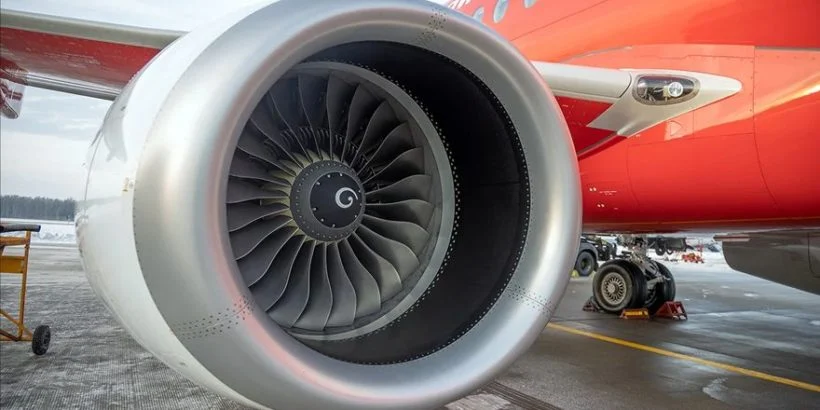
Russia’s United Engine Corporation (UEC) has developed the PD-8 turbofan as a new powerplant for the SJ-100 regional jet, retaining the installation dimensions required by the Superjet 100 airframe while introducing an independently designed gas generator and new technologies in the engine’s hot section.
The programme addresses the requirement to replace the Franco-Russian SaM146 engine without major changes to the aircraft’s existing wing and fuselage configuration. The PD-8 has a fan diameter of 1,228 mm, compared with 1,224 mm for the SaM146. Their bypass ratios are also close, at 4.4 and 4.43 respectively. These figures place the two engines in the same dimensional and aerodynamic category, but do not indicate commonality in their internal design.
The PD-8’s configuration reflects the aerodynamic characteristics of the Superjet 100. Its wing, developed with the Central Aerohydrodynamic Institute (TsAGI), has an aspect ratio of approximately 10 and incorporates fifth-generation supercritical aerofoil profiles optimised for cruise Mach numbers of 0.78–0.79. Swept wingtip devices, known as saberlets, further reduce induced drag. Alexander Dolotovsky, deputy managing director of Yakovlev and head of its Regional Aircraft division, has attributed a fuel-efficiency improvement of more than 4% to their installation.
These characteristics helped define the thrust and installation requirements for the replacement engine. The PD-8 was therefore designed around the existing Superjet propulsion arrangement rather than as a derivative of UEC’s larger PD-14 turbofan.
UEC chief designer Yuri Shmotin explained in 2019 that the PD-8 would require a lower core airflow than the PD-14. Differences in engine size, bypass ratio and overall pressure ratio also precluded a direct transfer of the larger engine’s gas-generator configuration. The PD-8 consequently received its own core architecture, although its development drew on engineering and manufacturing experience accumulated during the PD-14 programme.
That technological transfer covered aerodynamic design methods, compressor and turbine development, manufacturing processes for hot-section components, and approaches to structural integrity and service life. The PD-8’s compressor, combustor and high-pressure turbine were configured for the smaller engine’s airflow and operating conditions.
UEC has identified 25 critical technologies introduced in the PD-8, 17 of which it describes as newly developed. One of the more technically significant features is a supersonic stage in the high-pressure turbine. According to the manufacturer, gas pressure across this stage falls to one-quarter of its inlet value. The published information does not provide sufficient flow parameters or loss data to establish the stage’s contribution to overall turbine efficiency.
The high-pressure turbine also uses newly developed nickel-based heat-resistant alloys for its rotor blades and nozzle guide vanes. These materials are intended to withstand high thermal and mechanical loads in the engine’s hot section. Their performance is supported by a dedicated cooling system that protects highly stressed components.
Another measure aimed at improving turbine efficiency is the reduction of radial clearance between rotating blades and stationary components. Minimising these gaps limits gas leakage around the blade tips, allowing a greater proportion of the flow to perform useful work. UEC associates the use of minimum radial clearances with improved turbine efficiency and lower specific fuel consumption. Maintaining these clearances requires precise manufacturing and control, as well as allowance for thermal expansion of the rotor and casing across the engine’s operating range.
The combined use of heat-resistant materials, turbine cooling and tighter clearance control is intended to reduce losses in the hot section. However, UEC has not published data quantifying the individual contribution of these measures to the PD-8’s fuel consumption.
Published specifications give the PD-8 an overall pressure ratio of 28, compared with 27.53–27.97 for the SaM146. The stated cruise specific fuel consumption is 0.61 kg/(kgf·h) for the PD-8 and 0.63 kg/(kgf·h) for the SaM146. This represents a nominal difference of approximately 3.2% in favour of the Russian engine.
The figures indicate an improvement in the published cruise fuel-consumption specification, but do not constitute the results of a controlled comparison. A direct assessment would require matching altitude, Mach number, thrust, ambient temperature and measurement methodology. These conditions have not been disclosed in sufficient detail to establish the comparative performance of the two engines.
The PD-8 received its Russian type certificate, FATA 010108E, on 28 May 2026. The SaM146 is covered by EASA Type Certificate Data Sheet E.034, Issue 10, dated 11 July 2022.
The PD-8 programme therefore combines an installation envelope close to that of the SaM146 with an independently developed gas generator, technologies derived from the PD-14 programme and new hot-section solutions. Its published specifications indicate lower cruise specific fuel consumption than the SaM146, although the available data do not establish the precise contribution of individual design features or provide a fully comparable measure of the engines’ performance.