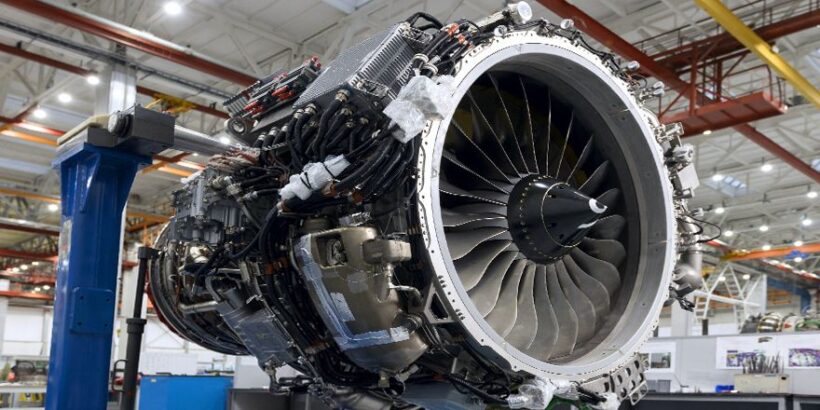
United Aircraft Corporation (UAC) has outlined the scope of its planned re-engining programme for in-service SSJ100 regional jets, confirming that between 50 and 100 aircraft powered by the Franco-Russian SaM146 turbofan are expected to be upgraded with Russia’s domestically developed PD-8 engine.
The programme targets aircraft already in commercial service and is intended to extend the operational life of the existing fleet as support for the SaM146 becomes increasingly constrained. Russian officials have previously estimated that about 140 SSJ100s remain in airline service, making the re-engining effort a key element of the country’s strategy to sustain regional air transport while transitioning to indigenous propulsion systems.
According to UAC Chief Executive Vadim Badekha, the modification will be limited to replacing the powerplant and integrating the PD-8 with the existing aircraft. The flight deck, avionics architecture and onboard systems will remain unchanged, reducing both the engineering effort and the certification burden compared with a wider aircraft redesign. Certification of the PD-8-powered legacy SSJ100 variant is already under way.
Badekha said the programme is expected to be financed by airline operators rather than through direct federal funding. Although UAC has not disclosed programme costs, he rejected media reports suggesting the upgrade could require investments exceeding RUB100 billion, describing those estimates as unrelated to the corporation’s internal assessments. He said both engine pricing and modification costs indicate that the project remains commercially viable for operators.
The PD-8 integration programme for the original SSJ100 is expected to complete development in 2027, after which UAC intends to begin serial conversions of aircraft in commercial service. The programme runs in parallel with certification of the fully import-substituted SJ-100, which was designed around the PD-8 from the outset.
Replacing the SaM146 has long been regarded as essential to maintaining the operational viability of Russia’s SSJ100 fleet. Access to overhaul services and spare parts for the Franco-Russian engine has deteriorated following Western sanctions, while the remaining запас of serviceable engines is finite. Earlier industry assessments acknowledged that the technical aspects of re-engining posed relatively limited challenges, with the principal constraint being the economics of replacing the powerplant across the existing fleet.
 (No Ratings Yet)
 Loading...