 RuAviation
Russian Engine Technologies Gain Recognition for Hybrid Propulsion and Advanced Manufacturing
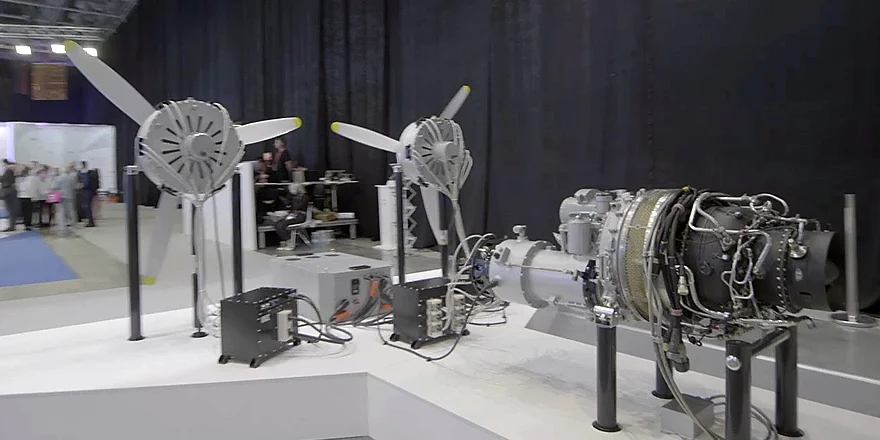
UEC’s hybrid propulsion system, manufacturing equipment for PD-8 turbine blades and inspection and materials technologies developed for the PD-14 and PD-35 have received awards in Russia’s 2025 Aircraft Builder of the Year competition.
The awards highlight developments in two areas of particular importance to Russian engine manufacturing: hybrid propulsion for future aircraft and domestic production technologies for advanced gas turbine engines.
The most significant award went to the GSU-500 hybrid propulsion system developed by Klimov, part of United Engine Corporation (UEC). Based on the VK-650V turboshaft engine, the system combines a gas turbine, electric motors, a generator, battery packs and power electronics. The turbine drives the generator, which supplies electricity to the propulsion motors, while batteries provide additional power.
UEC is targeting the architecture at unmanned aircraft, air taxis and vertical or short take-off and landing (V/STOL) platforms. The company estimates that the system could reduce fuel consumption by up to 30% and offer greater range and endurance than fully electric propulsion systems. Design work was completed in 2025, and the GSU-500 demonstrator has completed bench testing. The project won the competition’s award for Best Innovative Aerospace Project.
Another Klimov development recognised by the competition supports the Strizh supersonic civil aircraft technology demonstrator programme. Developed with the Zhukovsky National Research Centre, the Central Aerohydrodynamic Institute (TsAGI) and the Central Institute of Aviation Motors (CIAM), the propulsion installation uses two modified RD-93MS engines integrated with air intakes and oblique-cut rectangular exhaust nozzles.
Bench testing conducted by Klimov and TsAGI confirmed that engine thrust characteristics met the technical specification. TsAGI also developed an exhaust-noise suppression system for take-off conditions.
In the manufacturing sector, UEC-Saturn and research and production centre Lasers and Equipment TM developed a combined laser-erosion process for producing cooling holes in turbine blades and nozzle guide vanes with ceramic thermal barrier coatings. The partners have also produced domestic hybrid laser-erosion equipment, now used in the manufacture of PD-8 turbine blades.
The process enables manufacturers to create precisely controlled cooling perforations without damaging the protective ceramic coating. Internal airflow through the holes cools the blade, while air discharged onto its surface forms a protective film against the hot gas stream. Automated processing reduces manufacturing time and supports consistent hole geometry.
UEC-Aviadvigatel received recognition for two developments relevant to the PD-14 and PD-35 programmes. Working with the Kurchatov Institute’s VIAM materials research centre, the Perm-based engine manufacturer developed surface-hardening processes for domestic steels used in PD-14 engine bearings. The work focuses on chemical and heat treatment methods to improve the surface properties of bearing components.
The second development concerns non-destructive inspection of the PD-35’s polymer-composite fan blades. The digital radiographic system replaces conventional X-ray film with an array of digital detectors, enabling inspection of the entire component volume and identification of defects in adhesive joints between the composite blade and its metallic protective elements.
The awards ceremony took place in Moscow on 12 November 2026. The competition recognised the GSU-500 hybrid propulsion project, the PD-8 turbine-blade manufacturing technology, both UEC-Aviadvigatel developments and the collaborative Strizh propulsion project.