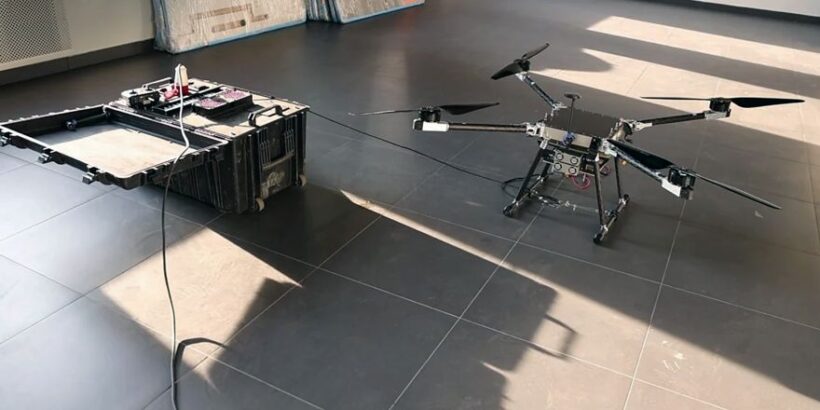
At a specialized event organized by the Kulibin Club, a public initiative under the All-Russian People’s Front, Russian engineers presented the Zephyr-M unmanned aerial vehicle (UAV), capable of continuous flight for up to 24 hours. The demonstration, held in Moscow in September 2025, showcased the technical capabilities and operational features of this new platform.
The Zephyr-M UAV is designed to enhance the effectiveness of strike drone systems and electronic warfare (EW) assets by extending the communication relay range. Its capabilities strengthen the infrastructure for UAV control and address current challenges in airspace security and management.
The system comprises the Zephyr-M drone and a ground station, with communication and power supplied via radio link or fiber-optic cable. An intelligent cable tension management system, integrated into the ground station, enables reliable operation in adverse weather conditions. Depending on configuration and mission requirements, the Zephyr-M can carry payloads ranging from 9 to 66 pounds (4 to 30 kg).
The drone can hover for up to 24 hours before requiring a technical break due to engine and component limitations. In certain scenarios, endurance may be extended, subject to operational constraints. Payload options include radios, lighting equipment, and EW devices. Prolonged hovering without autonomous flight expands the drone’s applications—from military operations to infrastructure security and search-and-rescue missions.
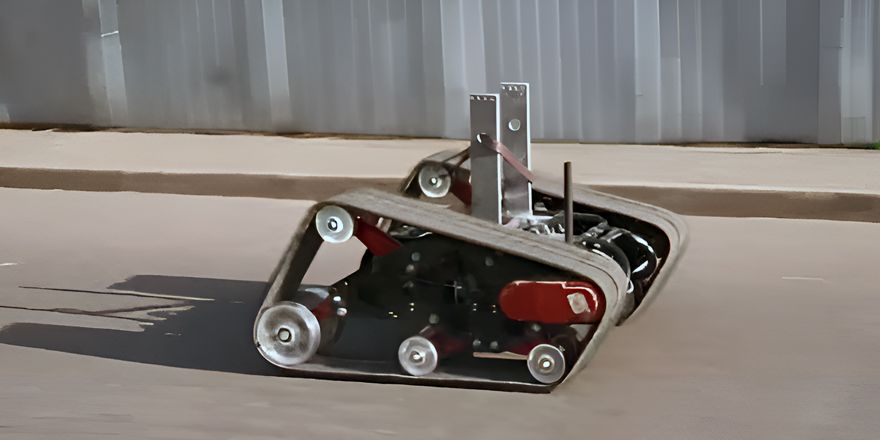
Developers also introduced the Atlas-M tracked robotic platform—a ground vehicle with a shock-absorbing suspension system that improves stability on uneven terrain. The platform can transport payloads from 220 to 440 pounds (100 to 200 kg) and tow up to 1,100 pounds (500 kg). These features enable effective navigation of challenging terrain with a maximum incline of 45 degrees.
Within the system, Atlas-M serves as a mobile ground station, providing communication and control for the Zephyr-M drone. The combined operation of these units extends the signal relay range up to 31 miles (50 km), significantly increasing UAV effectiveness in contemporary combat scenarios.
The integration of UAV and autonomous ground base ensures stable system performance for both military and civilian missions. This comprehensive approach enhances system efficiency and adaptability in rapidly changing environments. The development responds to the growing demand for multifunctional mobile complexes in special military operations (SMO), offering expanded operational capabilities and reliable support at a safe distance from the front line.
 (No Ratings Yet)
 Loading...