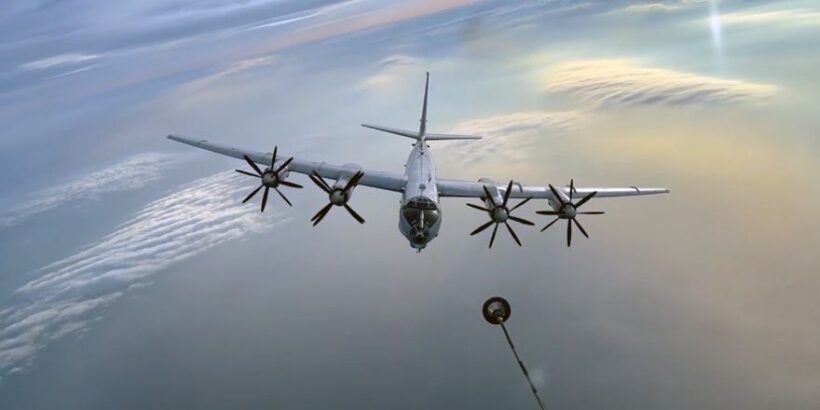
Russia’s Naval Aviation has marked 110 years since the first air combat engagement involving Russian naval aviators, an event that is recognised by the Russian Navy as the foundation date of the service.
The milestone is linked to a 17 July 1916 engagement over the Baltic Sea, when four seaplanes operating from the Russian seaplane carrier Orlitsa engaged four German aircraft while supporting the defence of a naval base on Saaremaa island. Two German aircraft were shot down and two others withdrew from the area.
The development of Russia’s naval aviation capability began with the conversion of the passenger ship Imperatritsa Mariya into a seaplane carrier. The vessel, renamed Orlitsa after modification, entered Baltic Fleet service on 20 April 1915 and operated four seaplanes launched and recovered using deck-mounted handling equipment.
Orlitsa initially carried French F.B.A. flying boats before they were replaced by Russian-built M-9 seaplanes designed by Dmitry Grigorovich. The aircraft introduced offensive capabilities, including machine-gun armament and the ability to carry bombs, and were used during the 1916 Baltic air engagement.
The scheme of a new anti-submarine aircraft for the aviation of the Russian Navy has been approved
Today, Russian Naval Aviation operates as a branch of the Russian Navy responsible for maritime reconnaissance, anti-surface warfare, anti-submarine operations, air defence support, mine-laying, transport missions, and search-and-rescue operations.
The service operates a mix of fixed-wing aircraft and helicopters, including the Su-30SM2 multirole fighter, Ka-27PL anti-submarine warfare (ASW) helicopter, Il-38 Novella maritime patrol aircraft, and Tu-142MZ long-range ASW aircraft.
The Su-30SM2 can carry up to 8,000 kg of external weapons on 12 hardpoints. Its weapons suite includes R-37M and R-77-1 air-to-air missiles, Kh-35U and Kh-31A anti-ship missiles, Kh-32 missiles, and an internal 30 mm GSh-30-1 cannon.
The Ka-27PL helicopter is configured for anti-submarine missions and carries AT-1M or UMGT-1 torpedoes, APR-2 rocket torpedoes, and PLAB-250-120 depth charges. Its sensor suite includes the Ros-V dipping sonar, search radar, and acoustic sonobuoys.
The MQ-9 Reaper UAV went down in the Black Sea after two Su-27s appeared nearby
The Il-38 Novella maritime patrol aircraft can carry up to 9 tonnes of payload, including AT-1/UMGT-1 torpedoes, APR-2 missiles, naval mines, and acoustic buoys. The aircraft is equipped with the Novella-P-38 search-and-targeting system, which provides detection ranges of up to 320 km against surface targets and up to 150 km against submarines.
The Tu-142MZ long-range ASW aircraft carries APR-3M anti-submarine torpedoes, depth charges, and naval mines. The aircraft is also equipped with a GSh-23 twin-barrel defensive cannon.
Ahead of the anniversary date, Pacific Fleet Naval Aviation units conducted flight-tactical exercises in Kamchatka involving Il-38N ASW aircraft, Ka-27 naval helicopters, and Ka-29 transport-combat helicopters.
During the exercise, a Ka-27PL crew conducted anti-submarine warfare training with the Project 20385 corvette Gremyashchiy in Avacha Bay. Il-38N crews carried out submarine search missions using acoustic systems and conducted simulated anti-submarine bombing runs.
Ka-29 crews also trained to locate and engage a simulated reconnaissance and sabotage group on the coastline using airborne weapons.
 (1 votes, average: 5.00 out of 5)
 Loading...