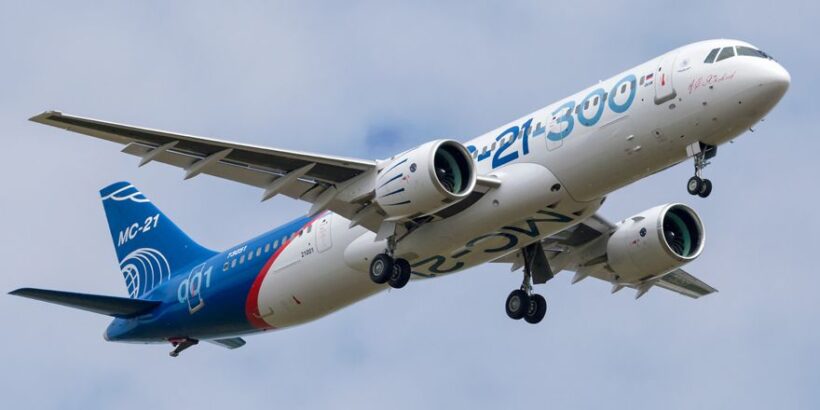
The Irkut MC-21-300 prototype (tail number 73051) completed its maiden flight on 28 May 2017 from the Irkutsk Aviation Plant airfield, marking the start of flight testing for Russia’s new single-aisle commercial aircraft.
The approximately 30-minute sortie evaluated basic handling qualities, stability, and propulsion performance with Pratt & Whitney PW1400G engines installed. Test pilots conducted a standard initial envelope expansion profile, including approach configuration simulation, a low pass over the runway, climb, and coordinated turns before landing. The aircraft was flown by test pilots and Heroes of Russia Oleg Kononenko and Roman Taskaev.
Earlier program milestones included the rollout ceremony on 8 June 2016, attended by senior government and industry representatives. In February 2016, Russian officials had publicly projected a possible first flight later that year.
Irkut executives characterized the maiden flight as a major milestone for the development team, highlighting aerodynamic design choices and an emphasis on passenger comfort and operating efficiency. United Aircraft Corporation (UAC) noted that the MC-21 is being developed through a distributed industrial base involving Irkut, AeroComposit, and manufacturing sites in Ulyanovsk and Voronezh.
After landing, the crew reported nominal aircraft behavior across tested regimes, with no restrictions identified for continuation of the flight test campaign. Engine and flight control systems operated within expected parameters throughout the sortie.
From 2018, the program structure began to shift under external supply chain constraints affecting key composite materials and subsystems. Restrictions linked to Western suppliers accelerated a redesign of the aircraft’s materials architecture and onboard systems integration.
The MC-21-310 variant emerged as a response to these constraints, incorporating domestically produced composite materials and a reconfigured systems baseline. A key change involved replacing the Pratt & Whitney PW1400G-JM engine with Russia’s PD-14 turbofan, which received type certification in October 2018.
The re-engined MC-21-310 conducted its first flight on 15 December 2020, marking the transition to a revised program baseline. Between 2019 and 2020, the aircraft underwent a phased redesign covering propulsion integration, materials substitution, and subsystem replacement as domestic supply chains were established.
After 2022, localization expanded further to include avionics, electrical systems, flight control components, and onboard computing architectures, requiring additional certification work for the modified configuration.
Current planning by Yakovlev and UAC targets entry into commercial service in the late 2020s, following completion of the expanded test campaign and stabilization of serial production. The MC-21 has effectively transitioned from a globally sourced development model to a predominantly domestically supplied aerospace program.
Over its development cycle, the MC-21 has become a case study in large-scale civil aviation reconfiguration, reflecting both industrial adaptation and the restructuring of aerospace supply chains under external constraints.

 (4 votes, average: 4.00 out of 5)
 Loading...