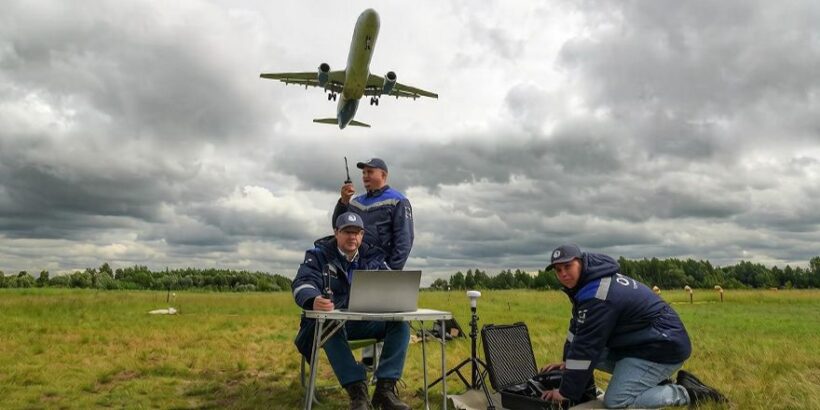
The import-substituted version of the SJ-100 regional jet has entered certification noise testing as part of its flight-test campaign, with trials being conducted at the Ramenskoye airfield in Zhukovsky, near Moscow.
The aircraft involved is prototype 97012 (manufacturer serial number 95157), operated by Yakovlev’s Regional Aircraft division together with the Gromov Flight Research Institute (LII). The campaign is aimed at verifying compliance with aviation noise requirements before the aircraft receives certification for commercial operation.
The noise assessment programme includes 12 flights, each lasting more than three hours. During each sortie, the aircraft performs approximately 20–25 take-off and landing profiles to measure lateral, approach, and overflight noise levels.
Measurements are conducted by an accredited LII testing laboratory using ground-based microphone stations. Between four and eight microphones are positioned at dedicated measurement points, while flight trajectory data, meteorological conditions, and aircraft parameters are recorded simultaneously. Data volumes from individual test sorties can exceed 100 GB.
The certification flights are performed under ICAO-defined meteorological conditions, as atmospheric pressure, temperature, humidity, wind speed, cloud cover, and vertical temperature profiles can affect acoustic measurements. Before each test flight, an Mi-8AMT helicopter operated by the institute’s atmospheric research laboratory performs weather sounding to verify that conditions remain within the required limits.
Flight-path accuracy is monitored using LII’s mobile optical measurement system (MOK-I), which provides real-time external trajectory tracking during certification trials. The system uses optical modules equipped with infrared, ultraviolet, and visible-spectrum cameras, combined with software that calculates the aircraft’s position from live video data.
Unlike conventional trajectory measurement systems that require post-flight data processing, MOK-I provides immediate feedback to the test crew. The system displays the aircraft’s position relative to the required flight corridor on crew tablets, allowing pilots to correct deviations during the sortie and reducing the risk of invalid test runs.
MOK-I has a maximum observation range of 20 km, with the highest trajectory measurement accuracy achieved at distances of up to 5 km. The system is currently used as a supporting tool during certification activities and is expected to gain formal measurement-system status after registration in Russia’s state metrology information system.
Completion of certification flight testing for the import-substituted SJ-100 is expected between late 2026 and the first quarter of 2027. The aircraft is being developed as a replacement for the original Superjet 100 configuration, incorporating domestically produced systems and the Russian-built PD-8 turbofan engine.

 (1 votes, average: 1.00 out of 5)
 Loading...