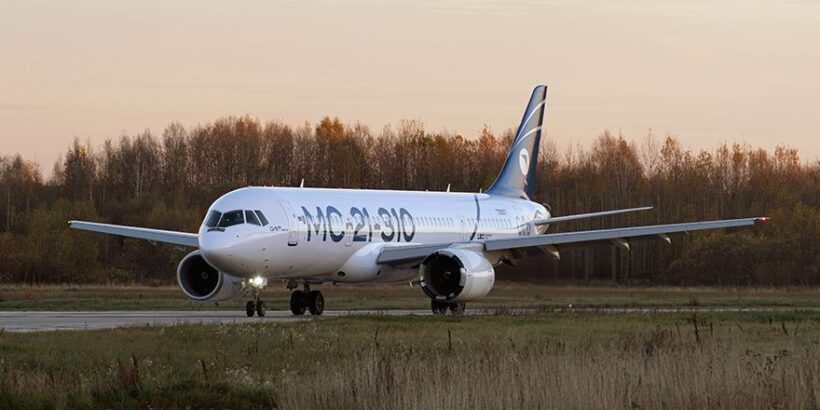
Russia’s MC-21 narrowbody programme has established domestic suppliers for aircraft systems previously sourced from a limited number of international manufacturers, according to Anatoliy Gaydanskiy, first deputy managing director and head of the engineering centre at Yakovlev. The programme has also developed industrial capabilities that could support future Russian widebody and long-range aircraft projects.
Gaydanskiy said the fully import-substituted MC-21-310 represents a shift from reliance on international aerospace supply chains to a domestically supported aircraft programme. Unlike Boeing and Airbus, which source systems from suppliers across multiple countries, Russian industry has had to establish its own design, manufacturing and integration capabilities for a broad range of equipment.
The programme has introduced Russian suppliers for systems including cabin water and waste management, emergency evacuation slides and airborne collision avoidance. Gaydanskiy cited Monogram as an example of a company that had previously supplied water and waste systems to the global market. Developing domestic alternatives has required the creation of new manufacturing capacity and supplier relationships, alongside the engineering work needed to integrate the equipment into the aircraft.
Aircraft 73055 (MC.0012) incorporates some imported systems, while aircraft 73057 (MC.0013) is fully import-substituted, according to Gaydanskiy. The first aircraft intended for Aeroflot are also expected to be free of imported systems. The airline is due to receive its first eight production aircraft in the fourth quarter of 2027.
The MC-21 programme’s wider significance lies in the industrial base developed during the import-substitution effort between 2021 and 2026. Gaydanskiy said the work involved thousands of enterprises and hundreds of thousands of people. He argued that the resulting capabilities could support the development of larger aircraft, although no specific widebody programme was identified.
The programme addresses a supply-chain vulnerability previously encountered with the Sukhoi Superjet 100 (SSJ100). In 2015, Russia discussed supplying approximately 100 SSJ100s to Iran, but the aircraft’s reliance on US-origin equipment complicated export approval. Components included hydraulic, fire-protection and oxygen systems, an auxiliary power unit, electrical power equipment, wheels and brakes. The proposed deliveries required authorisation from the US Treasury Department’s Office of Foreign Assets Control (OFAC).
Sukhoi Civil Aircraft subsequently explored the SSJ100R, a proposed variant intended to replace selected US-origin components with Russian equipment and increase the domestic content share by 10-15 percentage points. Memoranda of intent were signed with Iran Air Tour and Iran Aseman Airlines in 2018, with deliveries targeted from 2020. The proposed configuration did not lead to the anticipated deliveries.
Russia’s SJ-100 regional jet, which is undergoing certification, is intended to avoid the same dependence on foreign systems. The MC-21 and SJ-100 programmes therefore address both industrial resilience and the risk that foreign export-control decisions could constrain aircraft sales. However, domestic sourcing alone does not establish commercial competitiveness or guarantee access to international markets.
 (1 votes, average: 5.00 out of 5)
 Loading...
