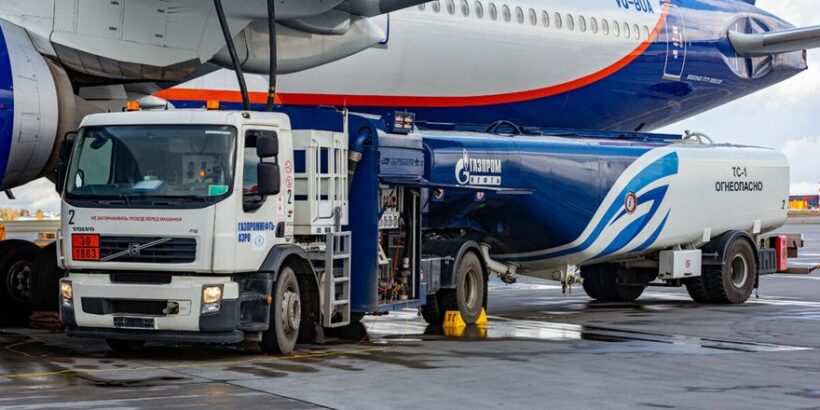
Russia has imposed restrictions on excess fuel uplift by foreign carriers at selected airports, responding to a sharp increase in tankering activity driven by rising global jet fuel prices.
Rosaviatsia, Russia’s civil aviation authority, confirmed that international operators have been taking on fuel volumes significantly above operational requirements at Russian diversion airports — a practice aimed at reducing overall fuel costs by exploiting the price differential between Russian and international markets. The regulator identified the trend as creating planning and logistics strain on fuel supply chains at affected facilities.
NOTAM advisories restricting foreign aircraft fuel uplift to route-specific requirements were issued in early June for Mineralnye Vody, Makhachkala and Nizhny Novgorod airports. The restrictions apply exclusively to non-Russian operators, domestic carriers are unaffected.
The tankering surge reflects broader pressure on airline fuel budgets following disruption to maritime logistics in the Strait of Hormuz, which has driven jet fuel prices sharply higher across several regional markets. Asian jet fuel prices have approximately doubled, and global air freight demand has contracted by 4.8%.
European carriers have borne significant operational impact: approximately 13,000 flights were lost from the European market in May alone, and Lufthansa Group has announced the cancellation of around 20,000 services through October. Against this backdrop, maximising fuel uplift at lower-cost locations has become a rational cost-mitigation measure for affected operators.
Russia has moved concurrently on the supply side. A government decree dated 2 June introduced a temporary ban on jet fuel exports, effective through 30 November 2026, with the stated objective of stabilising the domestic aviation fuel market. The NOTAM restrictions and the export prohibition together form a coherent regulatory response to protect domestic fuel availability during the peak summer operating season.
Rosaviatsia stated that Russian civil aviation operations are proceeding normally and that airports hold sufficient fuel inventory to meet schedules filed by domestic carriers.
 (No Ratings Yet)
 Loading...