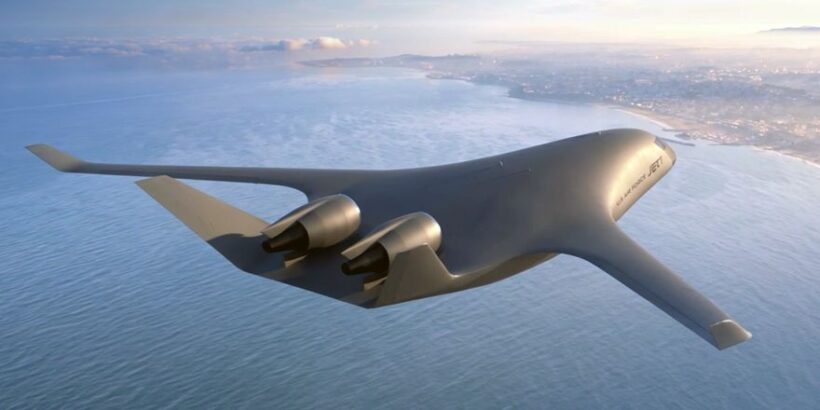
JetZero has begun construction of a production and assembly facility in Greensboro, North Carolina, advancing its blended-wing body (BWB) aircraft programme centred on the Z4 passenger concept. The company is targeting a first flight of its demonstrator in 2027 following a revised configuration presented ahead of the manufacturing phase.
The initiative is supported by a USD235 million contract awarded by the US Air Force in 2023 to mature a scalable BWB demonstrator. The programme is intended to assess potential gains in aerodynamic efficiency, with a focus on reduced fuel consumption and lower CO₂ emissions compared with conventional tube-and-wing architectures.
Blended-wing body configurations replace the conventional separation of fuselage and wing with an integrated lifting surface in which the airframe itself contributes significantly to overall lift generation. While this architecture offers theoretical efficiency advantages, it introduces structural, systems integration and certification challenges that have so far prevented its adoption in commercial service.
According to Alexander Chudnov, senior design engineering official within Yakovlev’s regional aircraft division, lifting-body concepts have been under investigation since the 1980s in both Soviet and Western programmes but have not progressed beyond research or pre-development phases.
He noted that the aerodynamic efficiency gains associated with BWB layouts are offset by structural penalties linked to non-cylindrical pressurised cabins. Such geometries require heavier load-bearing structures to sustain cabin pressurisation, increasing overall airframe mass and complicating structural design.
Cabin layout in BWB configurations departs significantly from conventional layouts, with interior volume tending towards wide, theatre-like arrangements. This introduces constraints on emergency egress design and complicates compliance with certification standards for evacuation performance.
Weight and balance management is also more restrictive. Fuel and payload distribution within the aft sections of the lifting body reduces allowable centre-of-gravity flexibility, increasing sensitivity to loading conditions and limiting operational adaptability compared with conventional designs.
Propulsion integration on the upper surface of the airframe can reduce aerodynamic interference but introduces penalties in maintenance accessibility, particularly when compared with widely used underwing engine installations.
Scalability remains a further limitation. Adjustments in passenger capacity within a 15–20 per cent range typically require substantial redesign of the lifting body structure rather than modular cabin reconfiguration, limiting the development of standardised aircraft families.
The long-term viability of the configuration is closely linked to advances in materials capable of delivering higher specific strength and stiffness than those currently available in aerospace-grade aluminium alloys and composite systems, particularly for complex pressurised structures.
The Z4 demonstrator is intended to provide empirical data on the performance and operational feasibility of the BWB configuration at scale. However, established tube-and-wing aircraft with underwing turbofan engines are expected to retain their dominant position in commercial aviation in the near to medium term, reflecting maturity in certification frameworks, operational flexibility and industrial infrastructure.
 (No Ratings Yet)
 Loading...