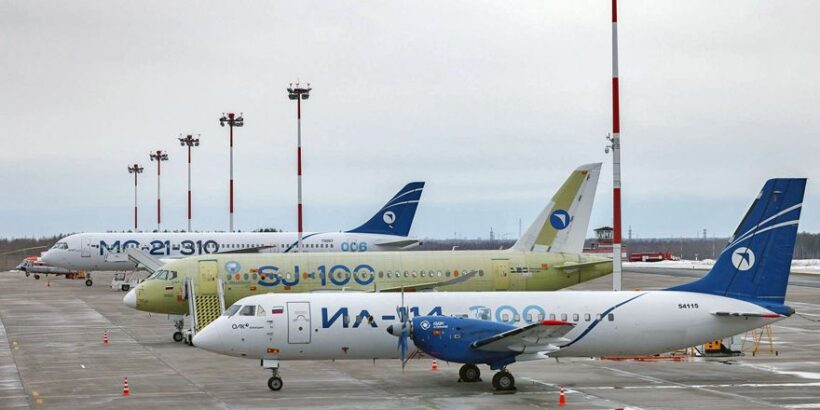
The implementation of the second phase of Russia’s civil aircraft delivery program through 2035 will require more than RUB 3 trillion (approximately USD 32–33 billion at current exchange rates). Deputy Minister of Industry and Trade Gennady Abramenkov announced this on April 14 at a meeting of the Federation Council Committee on Economic Policy, the upper house of Russia’s parliament.
Confirmed demand for new aircraft exceeds 570 units. According to United Aircraft Corporation (UAC) Civil Aviation Programs Director Oleg Bogomolov, the estimate was developed jointly with Sberbank and reflects demand from Russian airlines, excluding exports. The total number of aircraft remains under revision but is preliminarily assessed at over 500 units. Leasing terms and total cost of ownership (TCO) parameters have been aligned with airlines to ensure efficient fleet operations.
The demand structure includes 90 MC-21 aircraft for Aeroflot in addition to 18 already on order, 100 Tu-214 aircraft for S7 Airlines with deliveries starting in 2029, and 20 Il-114-300 turboprops for Aurora Airlines, a Far Eastern Russia-based regional carrier. UAC also plans to deliver at least 100 SJ-100 aircraft in its import-substitution configuration, taking into account the phased retirement of the existing fleet.
Bogomolov said commercial terms for the additional MC-21 batch for Aeroflot are in the final stage of negotiations. The aircraft’s baseline configuration and key performance parameters have been approved, and the operator support and aftermarket services framework is being finalized.
The first batch includes more than 70 contracted aircraft: 18 MC-21s, 42 SJ-100s, 11 Tu-214s, and three Il-114-300s. Deliveries will be distributed among Aeroflot Group, Red Wings, Azimuth Airlines, Aurora, and the Second Arkhangelsk Aviation Detachment (a state-run regional operator). MC-21 deliveries are scheduled for 2026–2027. Serial production is already underway using baseline design documentation, with certification-driven changes incorporated into production aircraft as required.
Abramenkov highlighted strong demand for the Il-114-300 regional turboprop, citing its performance characteristics and operating economics at a cost level comparable to peer aircraft. The aircraft has completed its certification program, logging 336 flights. The first three production aircraft are nearing completion and are scheduled for delivery by the end of 2026.
Certification flight testing of the SJ-100 is expected to be completed within the next two to three months. The program is currently achieving approximately 25 qualifying flights per month, keeping the program on track for completion within that timeframe. At the Komsomolsk-on-Amur production site, 26 out of 42 contracted aircraft are at various stages of completion, with the first 12 in advanced readiness.
The Ministry of Industry and Trade previously stated that SJ-100 certification is expected in August 2026, while the MC-21-310 is scheduled for October 2026. Timelines depend on test results and findings from the certifying authority.
Aircraft production targets are defined in the Comprehensive Program for the Development of the Aviation Industry through 2030. The current version calls for the production of 994 aircraft, including 592 at UAC facilities and 402 at UZGA (Ural Civil Aviation Plant). The program is being updated and has been submitted to the government for review.
The sector continues to rely on state-backed financing, including potential use of the National Wealth Fund or direct budget subsidies. Previously, RUB 283.8 billion (approximately USD 3.0–3.2 billion at current exchange rates) was allocated to expand production capacity through bond financing with preferential interest rates.

 (2 votes, average: 3.00 out of 5)
 Loading...