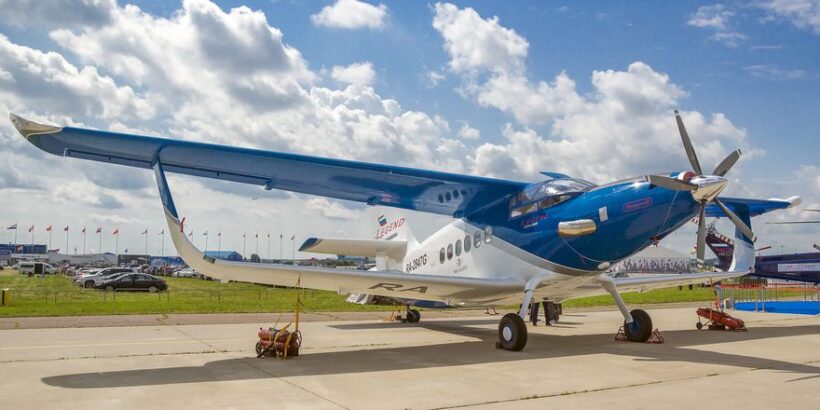
Russia’s development of the VK-1600S turboprop could remove one of the main barriers to the revival of the TVS-2DTS, a composite aircraft developed as a successor to the An-2.
The VK-1600S is being developed by UEC-Klimov as a turboprop derivative of the VK-1600V turboshaft. The engine is rated in the 1,100–1,450 hp class, with 60–65% commonality with the helicopter engine. Development work is being conducted under a RUB 3.376 billion contract signed between United Engine Corporation and the Russian Ministry of Industry and Trade in May 2025.
The development programme is structured around completion of the engine by the end of 2027. Work in 2026 includes completion of the test stand, assembly of a demonstrator and bench testing to establish the performance of its major assemblies. Three prototype engines are then to undergo initial endurance and special tests, followed by preparation for flight testing aboard an airborne laboratory.
Two additional prototypes are scheduled for production in 2027. The programme also calls for flight-development testing, ground certification tests and a 150-hour endurance test. Completion is intended to support type certification of the VK-1600S and release of production design documentation.
The engine is being positioned for more than a single aircraft application. The Ministry of Industry and Trade’s development requirements specify integration of the VK-1600S with both the An-2 and TVS-2DTS, as well as other light aircraft. This makes the engine programme relevant to the replacement of the An-2 fleet rather than simply to a single airframe project.
The An-2 remains dependent on the 1,000 hp-class Ash-62IR radial engine, which operates on aviation gasoline. Russia currently lacks a domestically produced turboprop in the required power range for a large-scale re-engining programme. A previous attempt to address the requirement used the Honeywell TPE331. Between 2010 and 2015, SibNIA developed the TVS-2MS conversion of the An-2, and 29 aircraft had been modified in Novosibirsk by early 2025. Sanctions and limited production capacity prevented the programme from progressing to series production.
The An-2 received a new Russian type certificate in July 2026, providing a regulatory basis for further modernisation. The certified configuration currently accommodates nine passengers. A 12-seat configuration would require additional certification against AP-23 requirements.
Planned upgrades include changes to the flight-control system, additional fuel tanks and a glass cockpit. The availability of a domestic turboprop would address the principal propulsion constraint.
The TVS-2DTS represents a different approach to An-2 replacement. Developed by SibNIA as a technology demonstrator, it retained the An-2’s basic biplane configuration but replaced its metal airframe with an all-composite structure and introduced modern avionics. The aircraft was later associated with the Baikal designation as preparations were made for potential series production at the Ulan-Ude Aviation Plant.
The programme was subsequently suspended. Alongside the lack of a suitable domestic engine, it depended on imported components and required production capabilities for large composite aerospace structures that were not then available in Russia. SibNIA director Vladimir Barsuk said in 2020 that the absence of an industrial and technological base for series production of an aircraft in the An-2 class was among the reasons for the programme’s halt.
The industrial position has since changed. Russian aerospace manufacturers have developed capabilities for producing large composite structures from domestically sourced materials and established a wider domestic supplier base for aircraft systems. The VK-1600S would address another outstanding requirement: a locally developed turboprop in the appropriate power class.
The potential significance of the engine programme therefore extends beyond re-engining existing An-2s. If the VK-1600S reaches certification and series production, together with the required composite structures and onboard systems, the technical basis would exist to reconsider the TVS-2DTS as a production aircraft rather than as a technology demonstrator.
 (No Ratings Yet)
 Loading...