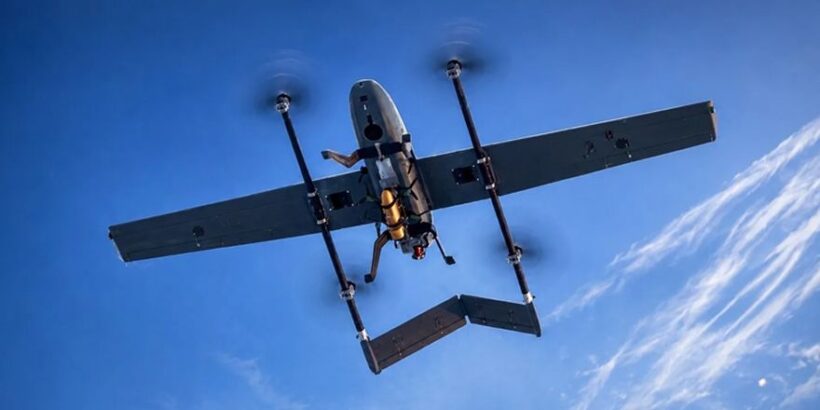
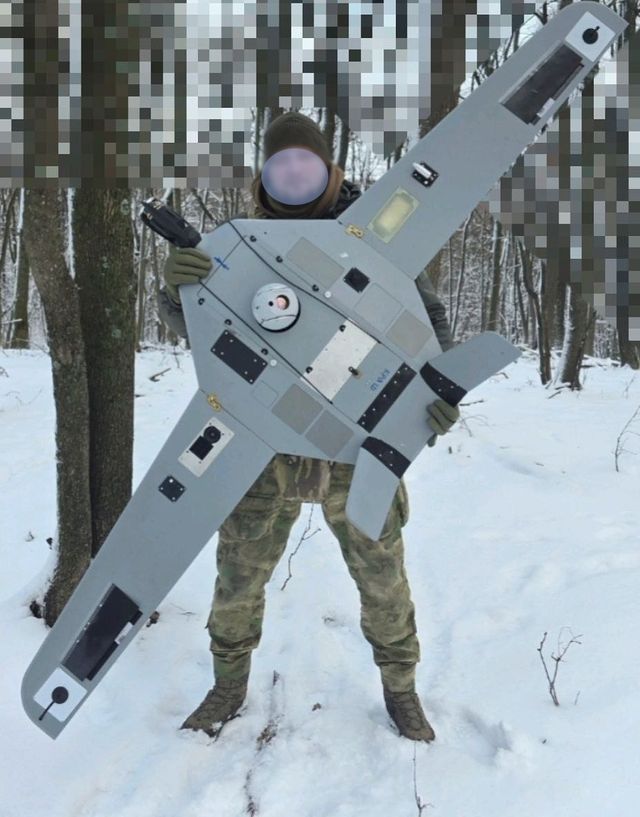
Kalashnikov Concern will showcase its SKAT-220 unmanned aerial vehicle and the Fortis vertical takeoff and landing (VTOL) unmanned systems family at the International Security Forum under the auspices of Russia’s Security Council. The event is scheduled for 26-29 May 2026 at the Live Arena complex in Novoivanovskoye, Moscow Region.
The SKAT-220 is a compact derivative of the SKAT-350M reconnaissance UAV, featuring a 2.2 m wingspan and a maximum takeoff weight of 12 kg. The electrically powered platform is launched via catapult and recovered by parachute. Kalashnikov states a maximum speed of 160 km/h and an endurance exceeding 150 minutes. The system is intended for surveillance and monitoring of critical infrastructure, including energy facilities, transport corridors, and power transmission networks, as well as environmental and agricultural applications.
The Fortis VTOL family is designed as a modular UAV platform for cargo transport, aerial monitoring, and FPV drone carriage with command relay functionality after payload deployment. The systems are reported to operate at ranges of up to 100 km, carry payloads of up to 18 kg, and achieve endurance of up to eight hours.
The family comprises three variants. The Fortis-30 carries up to 5 kg at a cruise speed of up to 90 km/h with a ceiling of 2,500 m. The Fortis-50 supports up to 7 kg at up to 100 km/h and 3,000 m. The Fortis-100 is configured for payloads of up to 18 kg, with a cruise speed of up to 110 km/h and a service ceiling of 3,000 m.
A single Fortis system may include up to four air vehicles. Optional configurations include training simulators, operator familiarisation systems, and maintenance diagnostic equipment.
Open-source reporting does not confirm operational deployment of the Fortis family. However, the platform architecture and stated performance parameters indicate potential dual-use applications in logistics, surveillance, and ISR roles in environments with constrained infrastructure.
In 2025, Kalashnikov presented a maritime search-and-rescue configuration of the Fortis-50, featuring FPV drones equipped with rescue buoys carried under the wings and on a fuselage-mounted payload station.
 (No Ratings Yet)
 Loading...