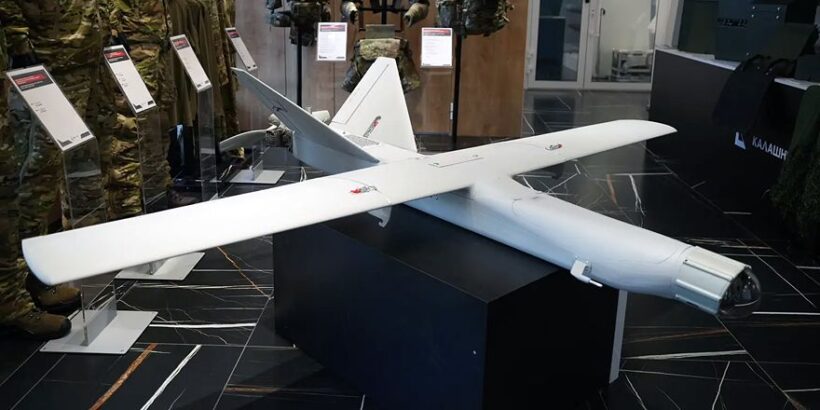
Kalashnikov has unveiled the Kub-10ME loitering munition, a tactical strike system with a stated range of more than 100 km, expanding the company’s family of expendable UAV-based strike assets.
The system was presented in Moscow and is described by the manufacturer as incorporating operational lessons from recent combat environments. While designed for tactical strike missions, the platform also integrates reconnaissance functions through onboard imaging and data recording systems.
Kub-10ME employs an electro-optical seeker and is capable of engaging moving targets. The system is also fitted with an onboard image-processing suite enabling automated detection and classification of objects within its field of view, supporting operator decision-making during target engagement cycles.
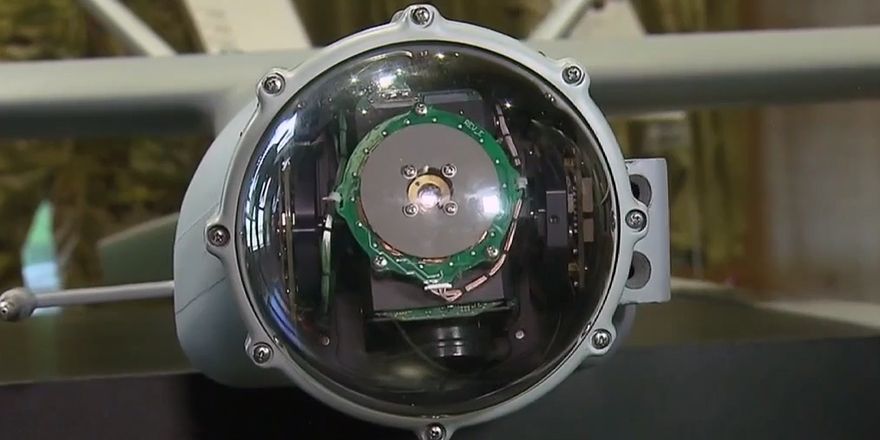
According to Kalashnikov, the guidance architecture has evolved from an initial coordinate-only mode to a seeker-assisted configuration, enabling a higher degree of target validation prior to engagement.
The company describes the target set as including lightly armored and unarmored vehicles, air defense assets, electronic warfare systems, command posts, logistics nodes, and parked rotary- and fixed-wing aircraft.
Leonid Rokeakh, head of export sales for unmanned systems at Kalashnikov, said the platform uses automated recognition algorithms trained on an onboard image library. The system provides probabilistic classification outputs to the operator, intended to support target confirmation rather than automate engagement decisions.
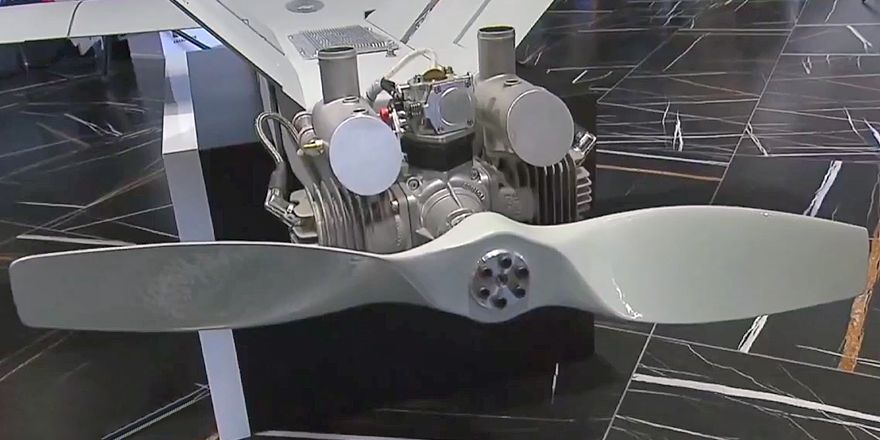
Kub-10ME operates at altitudes between 80 and 1,800 meters and has a cruise speed of approximately 120 km/h. It is designed for day-night operations in a broad range of environmental conditions, including wind gusts of up to 10 m/s, with an operating temperature envelope from −30°C to +40°C.
Kalashnikov says the system is designed for rapid operator training, with basic proficiency achievable after a short instruction cycle. Mission control is conducted via a tablet-based interface, with partial automation of navigation and flight adjustments through onboard decision-support algorithms.
 (No Ratings Yet)
 Loading...