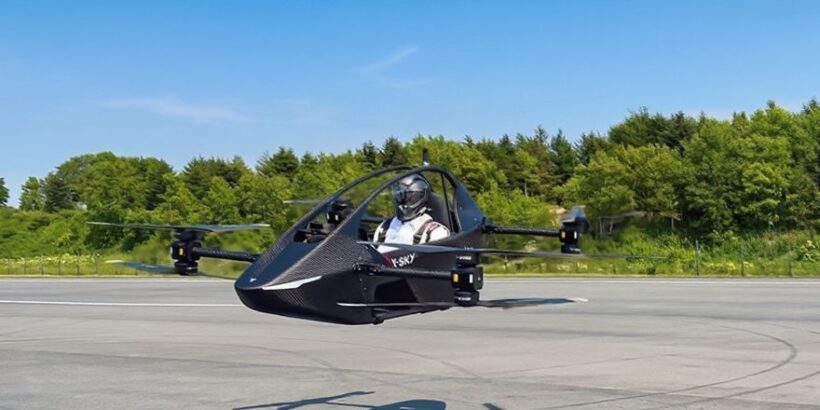
Russia has conducted the first officially authorised crewed flight of a domestically developed electric vertical take-off and landing (eVTOL) demonstrator under the country’s emerging regulatory framework for uncrewed aircraft systems (UAS), marking an early step towards integrating advanced air mobility platforms into the national aviation system.
The flight involved the single-seat X-Sky technology demonstrator and took place at the Pushisty drone operations centre on Sakhalin Island. Regional authorities described the sortie as the first crewed eVTOL flight to be formally conducted under Russian flight registration procedures rather than as a technology demonstration outside the regulatory framework.
X-Sky is a battery-powered multirotor aircraft designed to operate in both crewed and remotely piloted modes. The aircraft has an endurance of up to 20 minutes, a maximum speed of 50 km/h and relies on satellite navigation integrated with Russia’s ERA-GLONASS tracking network in both operating modes.
Although technically modest by international standards, the programme reflects Russia’s growing emphasis on regulatory infrastructure for advanced air mobility rather than on near-term commercial deployment. The Pushisty facility serves as the country’s first purpose-built drone operations centre, providing centralised flight management, telemetry monitoring and command-and-control services for experimental UAS operations.
The concept of operations also differs from that pursued by many Western and Chinese eVTOL developers. Rather than targeting urban passenger transport, the X-Sky programme is intended to support mobility in sparsely populated regions where limited transport infrastructure and long travel distances create demand for alternative air transport solutions. The ability to operate either with a pilot on board or under remote supervision forms part of that operational concept.
Russia remains well behind the leading eVTOL programmes in terms of certification and commercial readiness. China’s EHang has already introduced limited commercial passenger services using autonomous aircraft in approved operating environments, while US developers Joby Aviation and Archer Aviation continue progressing through FAA certification ahead of commercial entry into service. European programmes, including Volocopter, remain focused on certification and urban air mobility applications despite recent financial and industrial challenges.
For Russia, the significance of the X-Sky flight lies less in the aircraft itself than in establishing regulatory procedures for crewed eVTOL operations. The programme provides an initial framework for integrating advanced air mobility platforms into national airspace management as domestic developers continue work on future aircraft and supporting infrastructure.
 (No Ratings Yet)
 Loading...