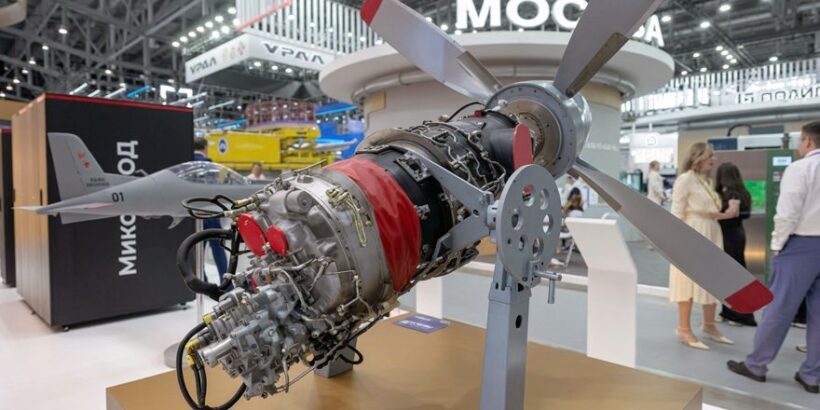
Russia’s Ural Civil Aviation Plant (UZGA) has started a 150-hour certification test campaign for the VK-800 turboprop engine, a key component of the country’s effort to introduce a domestic powerplant for light aircraft programmes.
The endurance campaign is being conducted on a dedicated test stand with participation from specialists of the Russian Aviation Register and the State Research Institute of Civil Aviation (GosNII GA). The programme will assess engine reliability, system performance and operational stability under high-load conditions representative of aircraft operation.
The VK-800S variant is being developed for the LMS-901 Baikal light utility aircraft, where the engine is undergoing certification alongside the airframe. The powerplant is also being considered for other Russian light aviation platforms, including the UTS-800 trainer aircraft and the Russian-Belarusian Osvey regional utility aircraft.
UZGA began development of the VK-800 in 2019, with the first gas generator assembled in 2022. Factory development testing started in 2023, and the design documentation reached the final “O” approval stage in 2024, indicating completion of the design phase and transition into the flight and certification programme.
The VK-800 family produces between 806 hp and 877 hp depending on configuration. The engine uses a conventional turboprop architecture with a centrifugal compressor, reverse-flow combustor, single-stage compressor turbine and two-stage free turbine.
Certification of the VK-800S and the AV-901 propeller for the LMS-901 Baikal is expected to be completed in 2027 under a government-backed development programme. The engine is also intended to support future fleet renewal efforts, including possible re-engining of locally assembled L-410 aircraft.
 (No Ratings Yet)
 Loading...