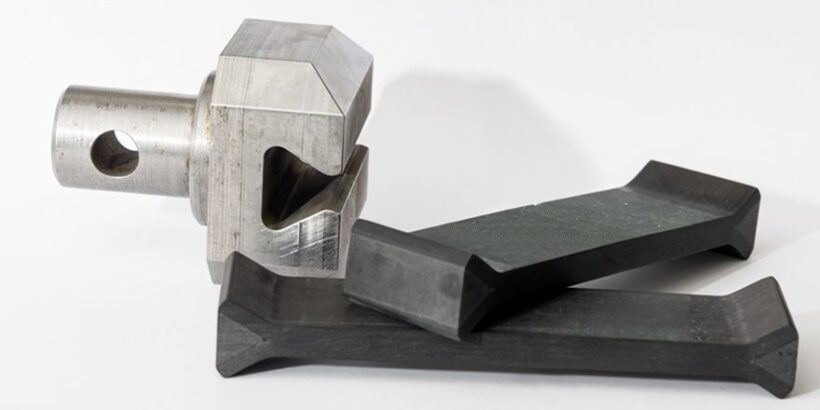
Researchers at the Moscow Aviation Institute (MAI) have developed and tested a manufacturing method for ultra-thin composite laminates that could reduce the weight of aircraft components by 20–25%. The technology uses individual composite layers 0.05 mm thick, compared with 0.13 mm for conventional material, allowing manufacturers to control laminate thickness more precisely and reduce excess material.
Conventional aerospace composites combine reinforcing fibres with a resin matrix, with successive plies oriented at different angles to provide the required strength and stiffness under tensile, compressive and torsional loads. Components typically require at least seven plies. However, standard ply thicknesses can make it difficult to meet precise design specifications without adding unnecessary mass. For example, two conventional 0.13 mm plies produce a 0.26 mm laminate, exceeding a nominal 0.2 mm requirement. The MAI method offers finer control over the laminate build-up.
The process could be applied to structural elements in aircraft wings, fuselages and empennages, as well as to flight-control surfaces. MAI identifies lightly loaded structures in light aircraft as a particularly promising application, where reducing structural mass can improve payload or endurance. The underlying ultra-thin composite technology has been used in medicine, electronics and other industries, but the institute has adapted it for aerospace component manufacture.
The development team produced material samples and compared their properties with those of conventional composites. Researchers used computed tomography and microscopy to examine internal defects, including microscopic voids that can compromise structural integrity, and subjected the samples to mechanical loading. The resulting data were used to calibrate computer models of the material and develop manufacturing recommendations.
The project was commissioned by Russian composite-materials company Prepreg-SKM and conducted under integrated scientific and technical programmes supporting the full innovation cycle. MAI said further research would examine the use of ultra-thin composites in aircraft panels and fuselage structures. The institute has not disclosed a target aircraft programme, a certification schedule or a timeline for industrial deployment.
 (No Ratings Yet)
 Loading...
