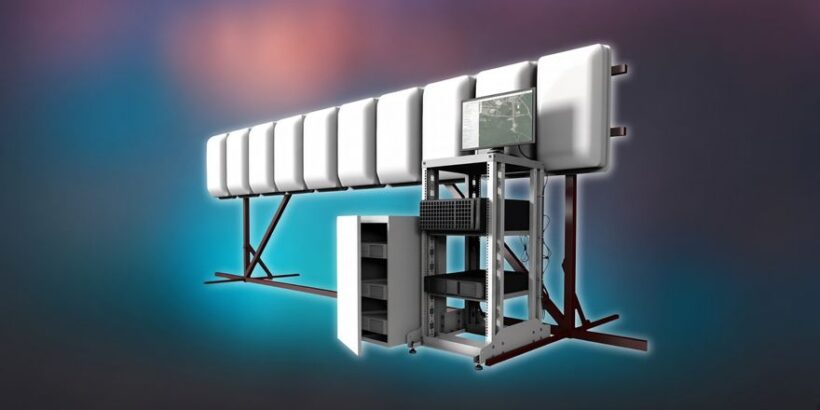
Russia’s Ruselectronics holding has developed a three-dimensional passive coherent locator, designated 3D PKL, for detecting small unmanned aerial vehicles (UAVs). The system uses signals from external transmitters rather than emitting its own radar energy, reducing the risk of detection by electronic intelligence (ELINT) systems.
The locator derives target coordinates from changes in the characteristics of reflected signals, including Doppler shifts associated with relative motion between the UAV, the illuminator and the receiving station. This approach allows the system to detect UAVs even when their onboard communications and global navigation satellite system (GNSS) receivers are switched off.
The absence of an onboard transmitter reduces the locator’s electromagnetic signature and could improve its survivability in environments where adversaries employ electronic surveillance and anti-radiation weapons. The system is intended for integration into counter-UAV architectures rather than operation as a standalone effecter.
Ruselectronics says 3D PKL can supply target data to electronic warfare (EW) and air defence systems. Potential integration options include the holding’s SERP and PRES electronic warfare systems, alongside radio-monitoring equipment, to support a layered approach to UAV detection and defeat.
The company also states that the locator’s signal-processing algorithms do not interfere with civilian equipment, allowing deployment in built-up urban areas and near airports. No information was provided on detection range, target-tracking accuracy, operational testing, production status or customer deliveries.
 (No Ratings Yet)
 Loading...