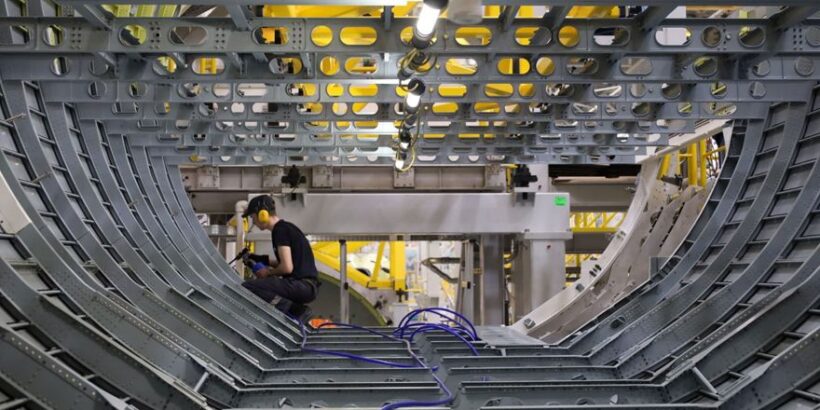
Russian aircraft manufacturer Yakovlev is expanding fatigue-life testing for MC-21 airframe components as part of a broader effort to improve production quality and reduce structural distortion in the narrowbody program.
The work is being carried out with Irkutsk National Research Technical University (INRTU) and aerospace manufacturing institute NIAT under Russia’s Priority 2030 industrial research initiative. Engineers are studying how different surface-treatment methods affect the long-term durability of aluminum and titanium aircraft parts used on the MC-21.
The research focuses on thin-walled structural components that can deform after machining and strengthening treatments. One of the techniques under evaluation uses roller burnishing to stabilize part geometry before assembly, helping reduce residual stress and improve dimensional accuracy.
According to the university, manufacturers often scale back strengthening intensity to prevent parts from warping during production. Earlier testing by Russian aerospace research organizations VIAM and NIAT showed that aluminum and titanium alloys respond differently to shot peening and related treatments under cyclic loading conditions, prompting additional studies in Irkutsk.
Since 2023, researchers have tested aluminum and titanium samples produced at the Irkutsk Aviation Plant using Yakovlev manufacturing specifications developed for the MC-21 program. After machining, the specimens undergo several types of surface treatment before being exposed to repeated stress cycles until failure.
The team is measuring how treated parts perform against untreated samples to determine which processes provide the largest durability gains. The study includes shot peening, abrasive blasting, vibration hardening and hole cold expansion methods already used in aircraft manufacturing.
Alexander Filippov, deputy head of Yakovlev’s structural analysis department, said the results will help engineers assess which strengthening techniques deliver the best balance between durability and weight reduction for the MC-21 and SJ-100 civil aircraft programs.
INRTU and Yakovlev are jointly handling statistical analysis and fatigue modeling for the project. Similar structural endurance testing in Russia has traditionally been concentrated at TsAGI, but the expansion of research work in Irkutsk is helping build a broader regional base for aerospace materials testing and airframe durability studies.
 (1 votes, average: 5.00 out of 5)
 Loading...