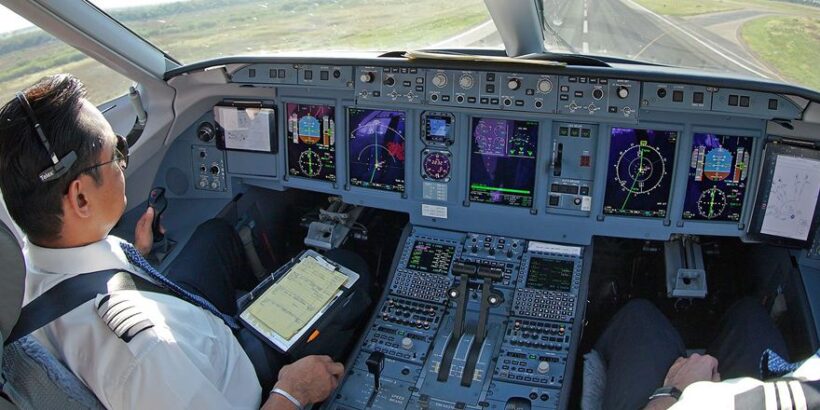
Russia’s SJ-100 regional jet programme is advancing the qualification of its domestically developed flight control system (FCS), with 1,500 tests conducted on 500 components and systems over three years. The campaign has assessed equipment performance under environmental extremes, electrical transients, mechanical loads and simulated failures as part of the aircraft’s import-substitution programme.
The FCS, developed by the Moscow Institute of Electromechanics and Automation (MIEA), part of the Radioelectronic Technologies Concern (KRET), converts pilot inputs into commands for the aircraft’s control actuators. The Russian design uses four redundant control channels based on different circuit architectures to reduce the risk of a common-mode failure affecting the entire system. The stated reliability requirement limits the probability of system failure to \(10^{-9}\).
Qualification testing has covered more than 30 categories of environmental and electromagnetic exposure. These include vibration, humidity, icing, salt mist, sand and dust, magnetic fields, radio-frequency interference, water ingress, fire safety and exposure to contaminating fluids. Engineers have also assessed structural integrity, service life, electrical power transients, and hardware and software compliance with applicable requirements.
Thermal testing has covered temperatures from −55°C to +85°C. Electronic units were assessed at +70°C for continued operation, while exposure at +85°C was used to examine resistance to extreme heat, including conditions intended to simulate a fire. Lightning-related electrical testing applied voltage pulses of up to 1,500 V.
The qualification programme also examines interactions between components at system level. Testing includes fault scenarios and endurance runs under changing temperatures, high humidity, vibration and aggressive environmental conditions. The objective is to establish whether individual failures, or credible combinations of faults, could compromise continued safe flight.
Eleven KRET enterprises are involved in the SJ-100 import-substitution effort, producing approximately 650 items of equipment. In addition to the FCS, their output includes avionics, control panels, external and internal lighting systems, hydraulic and fuel-system sensors and warning devices, and flight-data recording equipment.
Flight testing of two SJ-100 prototypes continued in September and October 2026, with activities in Belarus and Novosibirsk. In Belarus, crews assessed autopilot performance, automatic approaches and automatic landings under ICAO Category II and IIIA conditions using signals from global navigation satellite systems. The programme covered approximately 100 operating modes across different flight regimes, speeds and weather conditions.
In Novosibirsk, testing focused on the aircraft’s flight management computing system, including navigation equipment and position-fixing accuracy using VOR/DME radio-navigation aids. These activities form part of the broader effort to validate the aircraft’s domestically supplied avionics and navigation functions.
 (No Ratings Yet)
 Loading...
