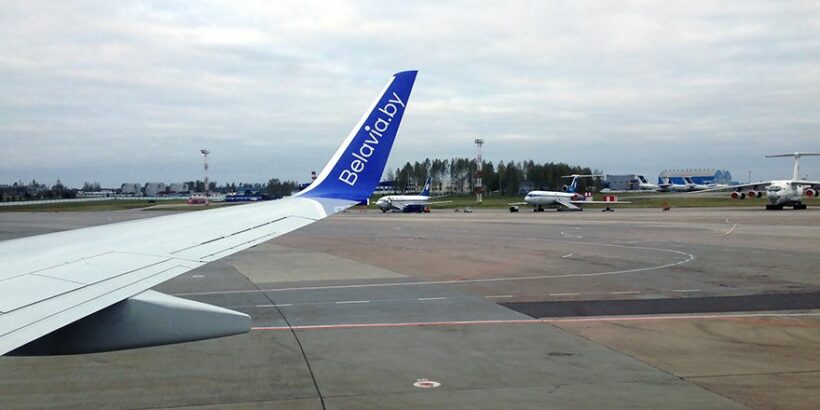
In early September 2025, the United States partially lifted sanctions imposed on Belarusian airline Belavia in August 2023. This change allows the carrier to perform maintenance and repairs on Boeing aircraft and procure original spare parts. At the same time, a Bureau of Industry and Security (BIS) letter dated September 12, 2025, introduced new restrictions: flights of these aircraft to Russia, Iran, Syria, and North Korea are prohibited.
The BIS restrictions apply to eight Boeing 737 aircraft operated by Belavia. Routine maintenance, overhauls, airworthiness restoration, and the purchase of original parts are allowed. However, flights to Russia require a separate BIS license, which is very difficult to obtain in practice.
Despite these limitations, Belavia continues to operate Boeing 737 flights to Russian cities. In October 2025, aircraft EW‑366PA flew from Minsk to Moscow, Saint Petersburg, Yekaterinburg, Sochi, and Makhachkala. EW‑254PA served Minsk–Saint Petersburg, and EW‑455PA operated routes including Moscow and Sochi. This information is confirmed by ADS-B tracking, Flightradar24, and ch-aviation. BIS classifies these planes as “covered aircraft,” meaning these flights formally violate the directive.
Belavia’s continued use of Boeings in Russia can be explained by several factors:
- Limited U.S. jurisdiction: flights are entirely within Belarusian and Russian airspace.
- Ownership: the aircraft are owned by Belavia, not leased from Western companies.
- Maintenance flexibility: some servicing may use non-original parts, reducing dependency on the U.S.
These factors allow the airline to operate while remaining technically compliant with legal constraints.
Belarusian President Alexander Lukashenko called the restrictions “stupid obligations,” noting that the partial lifting of sanctions shows their limited effectiveness. The continued flights of EW‑366PA, EW‑254PA, and EW‑455PA illustrate Belarus’ intent to maintain independence and ignore external political pressures.
On October 28, Russian Foreign Minister Sergey Lavrov described the U.S. restriction as a “disingenuous maneuver” at a press conference in Minsk following the III International Conference on Eurasian Security. He said:
“We welcome revisions of unlawful actions, especially when they no longer block mutually beneficial cooperation. But this partial lifting of sanctions is a very limited exception. In terms of flight range and spare parts, dependence on the U.S. remains. Ultimately, this is largely symbolic, while Belavia’s fleet continues to rely on the U.S. for spare parts and operational influence.”
Potential secondary sanctions on Russian airports are also significant. In practice, operators see BIS restrictions as manageable because Belavia’s flights remain within Belarusian and Russian airspace and comply with local laws. This limits the risk of international claims.
The airline is also expanding its fleet. On October 29, CEO Igor Cherginets said:
“Despite challenges from U.S. and EU sanctions, we acquired three Airbus A330s last year. Aircraft are essential for transporting passengers, so we will continue to expand our capabilities and destinations for our citizens.”
Overall, the continued operation of Boeing 737s to Russia demonstrates the limited effectiveness of U.S. sanctions. Belavia maintains regular service to Russian cities using legal avenues. While U.S. agencies attempt to influence operations, these measures do not prevent flights. The airline’s technical and operational flexibility shows that sanctions create the appearance of pressure without actually restricting operations, highlighting the limits of U.S. influence in the context of Russia–Belarus integration.
 (No Ratings Yet)
 Loading...