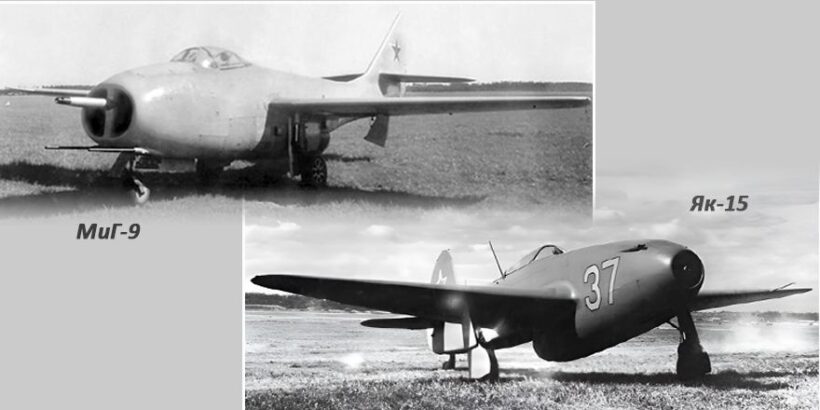
On April 24, 1946, the Soviet Union entered the jet age as two prototype fighters — the Mikoyan-Gurevich I-300 (later designated MiG-9) and the Yakovlev Yak-15 — completed their maiden flights at the Flight Research Institute (LII). The date is widely regarded as the starting point of Soviet operational jet combat aviation, marking the transition from experimental propulsion concepts to frontline-ready turbojet-powered aircraft.
Although earlier work had been conducted on rocket-powered designs such as the Bereznyak-Isayev BI-1 in 1942, those efforts remained strictly experimental and never led to serial production. The 1946 aircraft, by contrast, were the first Soviet fighters built around turbojet engines intended for scalable operational deployment.
Postwar urgency and captured technology
By the end of World War II, Soviet aviation faced a rapidly shifting technological balance. Western jet-powered aircraft had already demonstrated clear advantages in speed and altitude over the most advanced piston-engine fighters of the era. This created urgent pressure to accelerate indigenous jet development despite limited domestic experience in turbine propulsion.
In the absence of mature Soviet jet engines, designers relied on captured German technology. The Junkers Jumo 004 and BMW 003 turbojets — producing roughly 900 kgf and 800 kgf of thrust respectively — became the foundation for the first generation of Soviet engines. The Jumo 004 was reverse-engineered into the RD-10 at Plant No. 26 in Ufa under Vladimir Klimov, while the BMW 003 was developed into the RD-20 under Sergey Kolosov at Plant No. 16 in Kazan.
This dual-engine strategy enabled parallel aircraft development paths, balancing risk and accelerating learning across design bureaus.
MiG-9: twin-engine experimental combat architecture
The MiG-9, developed by Mikoyan-Gurevich Design Bureau (OKB-155), was conceived as a high-speed, heavily armed fighter. Design work began in June 1945 under the internal designation I-300, with initial plans centered on a twin BMW 003 installation.
Engine constraints strongly shaped the aircraft’s layout. The final configuration placed two turbojets side-by-side in the lower fuselage — an unconventional solution for its time. This arrangement preserved a relatively clean wing profile and reduced drag, but required a complex bifurcated nose intake system and strict aerodynamic balancing across both engines.
The MiG-9 featured an all-metal mid-wing configuration with straight double-spar wings and a TsAGI-designed airfoil section. Its elevated horizontal stabilizer was selected to mitigate jet exhaust interference and improve stability during thrust transitions.
Armament was concentrated in the nose and typically included a mix of a 57 mm or 37 mm cannon, supported by two 23 mm automatic cannons, providing high forward firepower optimized for short engagement windows typical of early jet combat.
Yak-15: transitional design based on a piston airframe
The Yak-15 emerged under a government directive issued in April 1945, tasking the Yakovlev design bureau with rapid jet conversion of the Yak-3 piston fighter.
Unlike the MiG-9’s clean-sheet approach, the Yak-15 retained much of the Yak-3’s structural framework, including its welded steel tube fuselage and aluminum skinning. A single Jumo 004-derived RD-10 engine was installed in a simplified configuration, allowing accelerated development and rapid production readiness.
The redesign included an enlarged vertical stabilizer and significant tail modifications to compensate for altered stability characteristics and jet exhaust effects. Armament consisted of two 23 mm NS-23 cannons mounted in the nose section.
Flight testing of the Yak-15 revealed several early jet-era challenges, including limited high-altitude engine performance, short engine life (approximately 25 hours nominal, often less in practice), structural vibration issues, and significant thermal effects on the rear fuselage. Jet exhaust erosion of runway surfaces and cockpit gas ingestion were also reported during early operations.
First flights and operational validation
On April 24, 1946, MiG-9 test pilot Alexei Grinchik conducted the aircraft’s first flight at 11:12 local time. The sortie lasted approximately six minutes and was completed without incident, followed by additional successful test flights in May.
Several hours later, at 13:56, test pilot Mikhail Ivanov completed the Yak-15’s maiden flight. Together, these events marked the formal beginning of Soviet operational jet combat aviation.
Early service risks and structural lessons
Despite successful initial testing, both aircraft quickly revealed structural and operational limitations inherent to first-generation jet design.
In July 1946, a MiG-9 crashed during a demonstration flight after structural failure in the wing root area led to loss of control and destruction of the aircraft. The incident prompted a redesign and reinforcement of the wing structure in subsequent production variants.
Jet operations during this period also carried high risk due to immature materials science, limited fatigue understanding, and rapidly evolving aerodynamic regimes.
Public demonstration and doctrinal shift
On May 1, 1947, both the Yak-15 and MiG-9 were showcased over Red Square in formation flyovers involving dozens of aircraft. The display signaled the Soviet Union’s rapid transition into the jet era and its intent to field jet combat aircraft at scale.
The parallel development of the Yak-15 and MiG-9 reflected two complementary engineering philosophies: evolutionary adaptation of an existing airframe versus clean-sheet design optimized for new propulsion systems. This dual-track approach allowed the Soviet aviation industry to rapidly accumulate operational experience while refining jet engine reliability and airframe integration.
Legacy
Lessons from the MiG-9 and Yak-15 directly informed the next generation of Soviet fighters. Aerodynamic refinement, engine reliability improvements, and structural strengthening efforts culminated in the MiG-15, which unified earlier design experience into the USSR’s first truly mass-produced, combat-effective jet fighter of the early Cold War era.
 (No Ratings Yet)
 Loading...