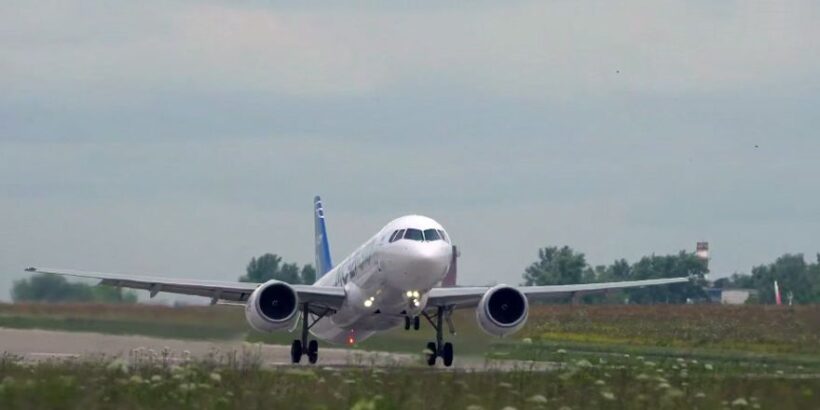
Russian President Vladimir Putin inspected three import-substituted airliners — the Yakovlev MC-21-310, the Sukhoi Superjet 100 (SJ-100), and the Ilyushin Il-114-300 — during a working visit to Zhukovsky on 24 June. The static display took place at the Ramenskoye airfield on the grounds of the Gromov Flight Research Institute (LII), where test pilots, industry officials, and representatives of United Aircraft Corporation (UAC) and its design bureaus briefed the president on program status.
Officials told Putin that two MC-21 test aircraft have together logged 200 flights, 101 of them in support of certification. MC-21 Chief Designer Vitaly Naryshkin said the flight test campaign is on track to conclude in June 2027.
Following the inspection, Putin chaired a meeting at which he urged the aviation sector to move faster and scale up domestic production, calling for expanded output of Russian-built aircraft to reduce reliance on imports. He flagged the risk of missing government air-travel targets and said federal authorities would continue to support the industry, while making clear that plant managers would remain personally accountable for delivery performance.
First Deputy Prime Minister Denis Manturov, who accompanied the president, told state broadcaster VGTRK that certification and serial production of the MC-21 are proceeding in parallel. He said type certification is now targeted for late 2027, with more than 20 airframes currently in production.
The timeline is not the first the government has floated. Certification targets for the MC-21-310 have shifted repeatedly since 2025. Sources within the aviation sector — including personnel at the Gromov Flight Research Institute — cited to Aviation21.ru two recurring factors behind the slippage.
- First, some suppliers of import-substituted components have struggled to meet delivery schedules for parts developed under Russia’s localization program.
- Second, the original schedules underestimated the complexity of the recertification effort: the first partially import-substituted MC-21-310 prototype (registration 73055) did not begin certification flights until summer 2025, and a second aircraft, 73057, only joined the program in late November of that year.
The supplementary certification campaign for the import-substituted variant formally began on 27 June 2025, when 73055 flew its first certification-credit sortie from Ramenskoye. Yakovlev estimates the full campaign — roughly 220 to 230 certification-credit flights across the two aircraft — will take between one and one-and-a-half years to complete. Once finished, the resulting evidentiary package goes to Rosaviatsia, Russia’s federal air transport agency, for review before Yakovlev can secure approval of the major design changes required to amend the type certificate. Industry observers note that this kind of schedule slippage is not unique to the MC-21 program: Boeing’s 777X has seen its own certification and entry-into-service dates repeatedly pushed back.
There is no guarantee the current end-2027 target will hold up any better than its predecessors. As far back as 19 March 2025, Yakovlev test pilot and Hero of Russia Roman Taskaev told an aviation enthusiasts’ gathering in Zhukovsky that certification delays would likely keep the MC-21 out of passenger service until 2028 at the earliest.
Rosaviatsia puts the flight certification program at roughly 45 percent complete. Most of the remaining work involves qualifying import-substituted components and compiling the airworthiness evidence needed to demonstrate compliance. Some components have already received approval; others remain under review.
Yakovlev’s internal target remains a type certificate by June 2027, while government statements point to a broader certification cycle wrapping up by the end of that year. The gap reflects the fact that flight testing and the associated paperwork are running on separate, overlapping tracks. In parallel with certification, Yakovlev continues to build out production capacity. The company estimates roughly three years to manufacture a single aircraft under current conditions, with the ramp-up in build rate tied to the phased completion of testing and the approval of key systems.
* * *
UAC is finishing production of the first serial MC-21 destined for Aeroflot. The carrier’s existing contract calls for 18 aircraft, all of which are now in advanced stages of assembly at the Irkutsk Aviation Plant.
Separately, UAC and Aeroflot have settled nearly all terms — including lease conditions — for a new order covering 90 additional MC-21s, and the airline says it is ready to sign a firm contract. Aeroflot’s MC-21 fleet could eventually grow to 200 aircraft.
UAC leadership says the transition to serial production is effectively complete, with delivery of the first aircraft expected imminently. The company describes its production schedule as synchronized with the certification campaign and with the broader delivery timeline for customers.
On pricing, the program anticipates unit costs falling as production ramps up. Ahead of the St. Petersburg International Economic Forum (SPIEF), Manturov told the newspaper Kommersant on 3 June that the MC-21 is currently priced at roughly 7.4 billion rubles (approximately $96 million at current exchange rates), with production costs expected to decline over time. During early deliveries, the government will bridge the gap between production cost and contract price through state support mechanisms.
* * *
The Altai Tyre Combine (АШК) passed a Yakovlev audit in June, retaining its status as an approved supplier of aircraft tyres for the MC-21-310 program. Auditors raised two significant findings but judged the supplier broadly compliant with Yakovlev’s requirements.
The audit covered the supplier’s quality management system, documentation, production facilities, manufacturing processes, and tyre storage and distribution. Yakovlev specialists verified that actual production practices matched current process documentation. The supplier is required to close out the identified findings through the standard corrective-action process.
* * *
Flight testing in June was carried out by the two MC-21-310 prototypes, registrations 73055 (MC.0012) and 73057 (MC.0013), which together flew 13 sorties totaling 46 hours 5 minutes. The campaign focused on validating onboard systems, confirming flight performance, and characterizing takeoff and landing behavior.
Aircraft 73057 flew missions to confirm operational performance in representative conditions, including flights at a design payload of 17.5 tonnes (about 38,600 lb). Naryshkin said these flights demonstrated range in excess of 3,800 km (roughly 2,050 nm) while maintaining required fuel reserves.
UAC President Vadim Badekha told Russian news agency TASS ahead of SPIEF 2026, on 2 June, that confirmed MC-21 range will soon be extended to 4,000 km (about 2,160 nm), with further growth potential beyond that figure. He said the range already on offer satisfies airline requirements, covering 80 to 90 percent of carriers’ existing route networks.
According to Yakovlev’s flight test division, the June sorties were flown to closely replicate scheduled-service conditions, including alternate-airport planning and standard navigational reserves. On 3 and 4 June, the test aircraft flew range missions at a takeoff weight of 85 tonnes (about 187,400 lb) and exercised continued-takeoff procedures with a simulated engine failure. Takeoff distance and climb performance matched predicted values.
Pavel Sokut, head of Yakovlev’s flight test division, noted that airworthiness standards require that failure of one engine not produce a critical outcome at any phase of flight, including takeoff — a constraint that is especially limiting for a twin-engine aircraft and effectively caps maximum takeoff weight.
On 10, 15, and 17 June, aircraft 73057 conducted high-speed taxi runs and rejected takeoffs to evaluate landing-gear system performance. The aircraft also flew two short sorties to test the primary and backup landing-gear extension systems at maximum allowable speed, plus a flight accelerating to maximum speed with the gear extended.
Aircraft 73055 was used to evaluate the flight management system (FMS), radio-navigation equipment (ADF, VOR, and DME), the airborne collision avoidance system, and the fire-protection system. Testing also covered VHF communication range and the ground proximity warning system (GPWS).
Source: Aviation21.ru, “МС-21 – дайджест за июнь-2026” [https://aviation21.ru/ms-21-dajdzhest-za-iyun-2026/]
 (No Ratings Yet)
 Loading...