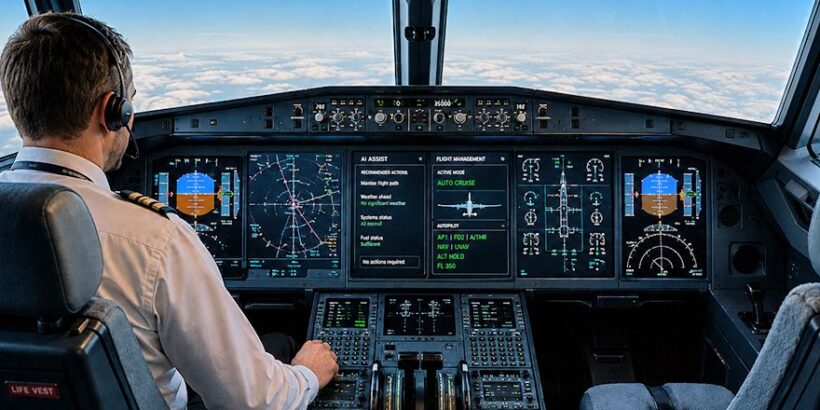
The State Research Institute of Aviation Systems (GosNIIAS) in Russia is developing cockpit automation technologies aimed at enabling future commercial aircraft operations with a single pilot on board, according to ongoing research into artificial intelligence–driven flight systems.
The initiative focuses on integrating AI-based systems capable of assuming a portion of crew workload traditionally handled by a second pilot, gradually reshaping the human–machine interface in the flight deck.
Andrei Popov, a senior specialist at the institute working on unmanned aviation systems, told RIA Novosti that modern automation already covers a significant share of flight operations without continuous manual input from the crew. He noted that current flight control architectures are capable of maintaining automated flight across most phases of a route under standard conditions.
According to Popov, pilot intervention is typically required during takeoff and landing, as well as in abnormal or non-standard flight situations. At the same time, a growing portion of routine tasks is already handled by automated control systems and decision-support algorithms embedded in modern avionics suites. Further development of artificial intelligence is being considered a key enabler for potential single-pilot operations in commercial aviation.
The concept of Single Pilot Operations (SPO) has been under discussion in the global aviation industry for several years. It centers on redistributing responsibilities between the pilot and onboard automation systems while maintaining full control authority over the aircraft. A key design challenge in SPO architectures is ensuring operational resilience in scenarios involving pilot incapacitation or inappropriate control inputs that could create safety risks.
Following the 2015 Germanwings Airbus A320 crash in the Alps—caused by deliberate actions of the co-pilot—the European Union Aviation Safety Agency (EASA) recommended that airlines ensure the continuous presence of at least two authorized personnel in the cockpit. Several carriers subsequently introduced procedures requiring a flight attendant to occupy the cockpit seat when one pilot temporarily leaves the flight deck.
Modern flight automation programs are increasingly incorporating algorithms designed to respond to scenarios in which a pilot becomes incapacitated or introduces unsafe control inputs. In such cases, automated systems are expected to maintain aircraft control either until mission completion or until control can be safely transferred to ground-based support functions.
“Several operational algorithms are currently under development at GosNIIAS, and the issue will definitely find its solution,” Popov said.

 (1 votes, average: 1.00 out of 5)
 Loading...