The first Soviet civil aircraft to obtain Western FAR Part 25 airworthiness certification was the Yakovlev Yak-40. Its type certificate was issued in Italy on March 30, 1972, and in West Germany on May 12, 1972.
For the Soviet aviation industry, certification was a practical commercial requirement. Access to foreign markets and international route operations required compliance with Western standards for structural integrity, stability, controllability, and fail-safe design.
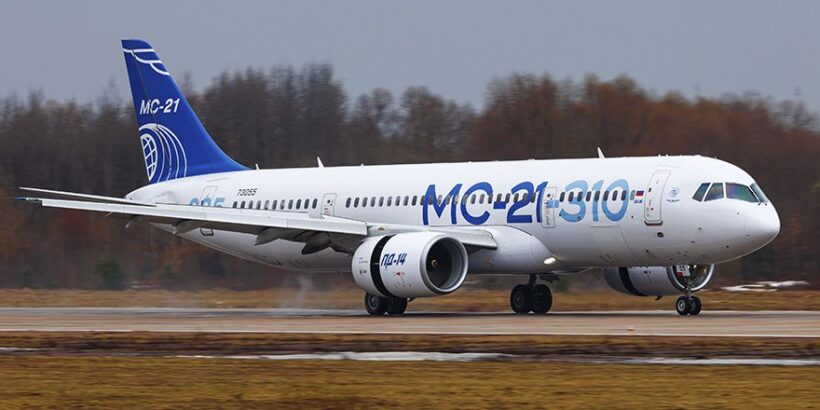
More than half a century later, the Irkut MC-21 is passing through a comparable phase. Like the Yak-40, the aircraft was developed by the Yakovlev design bureau. Flight certification trials began in summer 2017. Over that period, prototype aircraft equipped with a number of foreign-supplied systems generated the bulk of the required data on stability, controllability, and onboard system performance. The baseline type certificate was issued on December 28, 2021.
Testing is now focused on the import-substituted configuration. After replacing major systems and equipment, engineers must reconfirm previously validated performance characteristics and demonstrate continued compliance with the certification basis.
In April 2026, two MC-21-310 prototypes participated in the campaign: aircraft 73055 (MS.0012) and aircraft 73057 (MS.0013). The program logged 26 flights totaling 97 flight hours. A significant portion of the work focused on aircraft and system behavior under failure cases and abnormal operating conditions.
Aircraft 73055 supported evaluation of the terrain awareness and warning system (TAWS), radio altimeter, automatic direction finder (ADF), distance measuring equipment (DME) receivers, and the flight management system (FMS). Engineers also assessed the automatic cabin pressure control system, fire protection system, and auxiliary power unit (APU). On April 15, 21, and 22, the aircraft performed in-flight engine relight evaluations using multiple restart procedures.
Aircraft 73057 supported reconfirmation of previously established stability and controllability characteristics from the earlier foreign-equipped configuration, including minimum-speed testing. The automatic flight control system was also evaluated. On April 21 and 29, the aircraft conducted rejected takeoff tests to assess both normal and alternate braking performance without thrust reverser deployment.
Additional in-flight engine relight tests on aircraft 73057 took place on April 14, 15, 17, and 20. On April 22, 23, 24, and 30, engineers evaluated fuel system performance under multiple failure scenarios, including gravity-feed engine supply.
* * *
Russia’s Ministry of Industry and Trade said certification schedules for the import-substituted versions of the Yakovlev SJ-100 and the MC-21 may shift.
Speaking at an international transport and logistics forum, Anton Alikhanov said a substantial portion of the SJ-100 flight test campaign has already been completed, while the MC-21 has finished roughly one-third of its credit certification flights.
Certification timing will depend on test progress and on the closure of findings identified during the campaign.
The ministry still targets 2026 for the SJ-100 type certificate. For the MC-21, the flight test schedule remains intensive, with the objective of completing the certification cycle within a comparable timeframe. Schedule adjustments remain possible, but the baseline target remains approval of all major type design changes in 2026.
* * *
Aeroflot expects deliveries of new Russian-built aircraft to begin in late 2026 and has already started preparations for entry into service.
The airline is planning route deployment, crew training, and operational induction. Its stated objective is to introduce the aircraft into scheduled service while maintaining safety standards and passenger service levels comparable to the carrier’s current foreign-built fleet.
Aeroflot expects to receive 108 MC-21 aircraft by 2030. Over the longer term, the group plans to expand deliveries to 200 aircraft by 2033 and increase the share of domestically built aircraft in its fleet to 50% by 2035.
The airline identifies the MC-21-310 and SJ-100 as the core platforms of Russia’s civil aviation renewal program, alongside limited deliveries of the Tupolev Tu-214.
* * *
On April 6, 2026, Russia’s Federal Service for Intellectual Property granted Yakovlev a utility model patent covering a redesigned wing flap configuration for the MC-21-310. The design addresses aerodynamic losses in cruise caused by the junction between adjacent high-lift device sections.
In cruise configuration, the inboard and outboard flaps create a structural gap at the interface. Air flows through this gap from the lower wing surface to the upper surface, reducing local lift near the trailing edge.
Earlier Irkut MC-21-300 aircraft used imported flexible rubber seals at the flap section ends to mitigate the effect. Yakovlev engineers developed a movable flap-end element that operates through the existing kinematic mechanism without additional actuators.
With flaps retracted, the device closes the inter-section gap and reduces airflow leakage and associated vortex generation. When the flaps extend, the element automatically moves clear of the interaction zone without restricting flap motion or adding mechanical drag.
Production has been assigned to the Kazan branch of AeroComposit. Flight testing will be conducted on one of the prototype aircraft.
* * *
Funding for Russia’s civil aircraft delivery program for 2030–2035 is estimated at more than RUB 3 trillion. Confirmed aggregate demand exceeds 570 aircraft, excluding export deliveries.
The forecast includes about 90 additional MC-21 aircraft for Aeroflot beyond previously contracted volumes, 100 Tu-214 aircraft for S7 Airlines, around 20 Ilyushin Il-114-300 aircraft for regional operators, and at least 100 SJ-100 aircraft.
Aviation Interiors has developed the BA20 business-class seat for the MC-21. The seat has completed testing and certification, and preparations for serial production are underway. Initial installation batches have already been produced for the first aircraft.
Development begins with a digital passenger model. Engineers use the 95th-percentile anthropometric reference, meaning the seat geometry accommodates passengers up to approximately 6 ft 1.6 in (187 cm) in height.
The wider MC-21 fuselage gave designers additional flexibility and allowed greater emphasis on ergonomics rather than density alone.
During development, engineers evaluated seat widths of 20 in and 22 in. They ultimately selected 21 in as the best compromise between cabin density and passenger comfort across a broad range of body types.
The structural frame is certified for emergency loads of up to 16g. A two-seat assembly weighs between 128 and 165 lb, depending on configuration. That is roughly 10% lighter than comparable seats used on Airbus and Boeing aircraft.
The weight reduction was achieved through structural redesign and the use of flame-retardant polyurethane foam with reduced smoke generation.


 (3 votes, average: 3.67 out of 5)
 Loading...