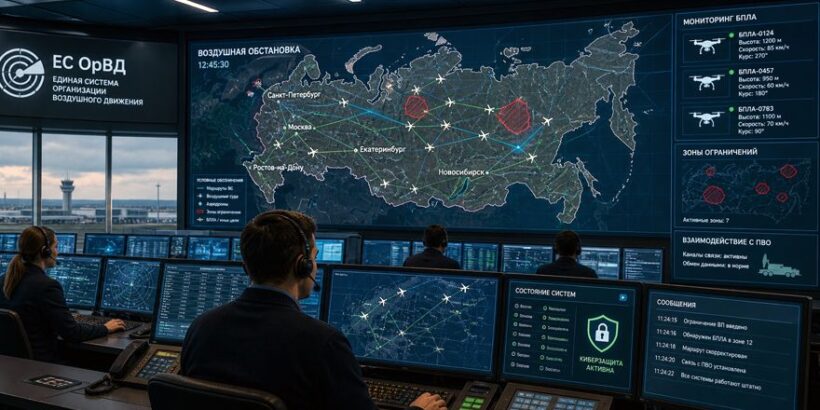
Almaz-Antey is testing an automated cybersecurity protection suite for Russia’s Unified Air Traffic Management System (ES OrVD), designed to detect and block cyber intrusions at the level of core automation infrastructure. The development was confirmed by Dmitry Savitsky, deputy CEO of the company.
The multifunctional system is being integrated into existing air traffic control architectures. It is designed to identify abnormal network activity, filter malicious traffic, and restore standard air traffic operations after airspace restrictions are lifted.
According to Savitsky, established coordination procedures between air traffic management authorities and air defense units help reduce the operational impact of airspace restrictions and shorten recovery times for civil aviation operations.
He also pointed to the resilience of Russia’s air traffic management infrastructure under elevated operational stress, including scenarios involving unmanned aerial system (UAS) activity.
“Let me put it clearly: the air traffic management system has never ‘lost stability.’ There have been no recorded failures in automation systems, surveillance equipment, or communications infrastructure. Air traffic control has not been interrupted for a single minute. Redundant surveillance channels allow us to maintain required monitoring parameters across all controlled airspace sectors,” Savitsky said in an interview with TASS.
During periods of airspace restrictions, response speed becomes a critical factor — from rerouting aircraft to alternate airports to coordinating takeoffs, landings, and removing aircraft from potentially hazardous zones. Savitsky noted that this depends heavily on coordination between air navigation service providers, flight planning systems, aeronautical data processing tools, and resilient communications links, including interfaces with air defense command structures.
“We have learned a great deal in recent times, including refining procedures and practices that improve coordination between air traffic control centers and air defense authorities. This is a critical function. The effectiveness of this coordination directly impacts civil aviation safety and the reliability of airspace management. In my view, it is invaluable operational experience,” he said.
Almaz-Antey also stated that air traffic management systems in the Moscow, St. Petersburg, and Rostov regions have demonstrated stable performance under increased operational loads. Recovery procedures following the lifting of airspace restrictions have already been validated and are being further automated, including the deployment of dedicated cybersecurity systems within the ES OrVD environment designed to counter complex cyberattacks and maintain stability of automated control infrastructure.

 (2 votes, average: 3.00 out of 5)
 Loading...