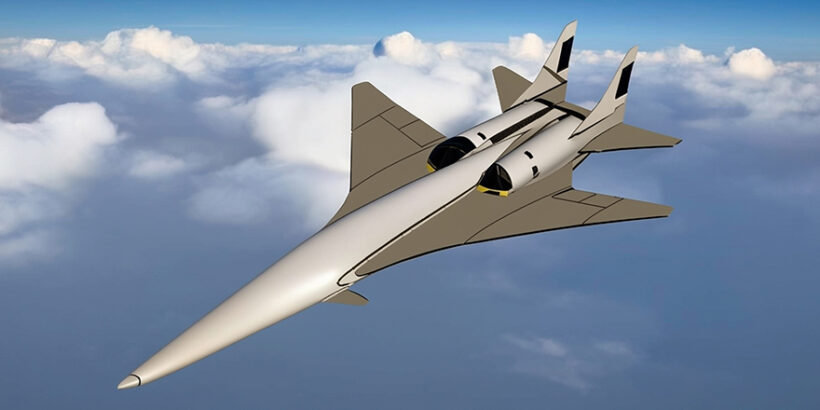
The patent defines a configuration for a civil supersonic aircraft in which sonic boom mitigation and takeoff and landing noise requirements are treated as a single integrated engineering problem. The design targets a cruise condition of Mach 1.7.
Patent RU2855196C1, titled “Supersonic Passenger Aircraft,” was granted on January 30, 2026, based on an application filed on September 29, 2025. The rights holder is the Federal State Budgetary Institution “National Research Center Zhukovsky Institute.” The specified design targets include Mach 1.7 cruise speed and a sonic boom level of approximately 95 PLdB, along with reduced takeoff and landing noise compared to conventional configurations.
In civil supersonic aviation, the Mach 1.7 regime is widely regarded as an operational sweet spot where wave drag, thermal loads, and the feasibility of geometric shock-wave shaping remain in balance. At lower speeds, transitional flow regimes dominate, characterized by unstable shock structures. At higher Mach numbers, propulsive energy demand increases sharply, while range efficiency becomes significantly more difficult to sustain.
Under these conditions, a sonic boom level of approximately 95 PLdB is treated as a speed-coupled design reference within the practically achievable envelope for a civil aircraft. At this level, the shock wave is no longer perceived as a sharp impulse typical of first-generation supersonic aircraft. However, further reduction requires substantial increases in geometric complexity and structural mass, which directly impacts aerodynamic efficiency and range.
The solution described in RU2855196C1 uses this coupled parameter set as a baseline for optimizing a known configuration. The patent specifies a propulsion system consisting of two engines installed in rear-mounted nacelles on the fuselage, with over-wing air intakes. Their spatial integration with airframe elements is used to reduce flow disturbances and achieve the required acoustic signature.
The novelty of the approach lies in treating the propulsion system not as a localized thrust source affecting only its own flow field, but as an active element of the aircraft’s overall wave-shaping architecture. Its placement relative to the wing and the nozzle configuration modifies the interaction between the exhaust jet and the external airflow, thereby influencing shock formation along the entire fuselage.
This shifts the design problem from optimizing individual aerodynamic surfaces to coordinating the airframe and propulsion system within a unified pressure field, where every major structural element contributes to the resulting ground-level acoustic footprint.
In this concept, the fuselage is no longer a uniformly smooth body. Its cross-section varies along the length so that the aircraft does not generate a single dominant shock wave at a specific point. Instead, the contribution to wave formation is distributed along the body, with each fuselage segment adding a portion of the disturbance slightly earlier or later than adjacent sections. As a result, the shock wave is effectively stretched along the flight direction. At ground level, it is perceived not as a single sharp impulse, but as a longer, smoother pressure event without a pronounced peak.
Traditional supersonic passenger aircraft, including early versions such as the Tupolev Tu-144 and Concorde, were primarily optimized for stable supersonic cruise and drag reduction, while sonic boom was treated as an unavoidable operational constraint. Later research shifted toward so-called low-boom configurations, where elongated fuselage shapes and carefully tailored aerodynamic contours redistribute pressure along the aircraft’s length.
The Zhukovsky Institute’s invention differs in that it elevates the propulsion system from a passive thrust provider to an integrated component of wave-field control. This extends acoustic shaping capabilities beyond purely aerodynamic airframe design. The practical significance of this approach lies in enabling a shift toward supersonic aircraft architectures where acoustic performance emerges from the interaction of all major subsystems operating in a unified regime, including both airframe geometry and propulsion flow management.
From an applied engineering perspective, this represents a transition from point-based optimization of individual components to system-level modeling of the entire shock-wave formation path. In the long term, this could reduce acoustic impact on ground infrastructure without requiring a radical increase in aircraft size or a shift to significantly higher cruise speeds. The key implication is that acoustic constraints remain the primary barrier to the return of commercial supersonic transport, and reducing sonic boom levels directly improves the feasibility of overland supersonic operations without fundamentally altering the economic model of operation.
 (No Ratings Yet)
 Loading...