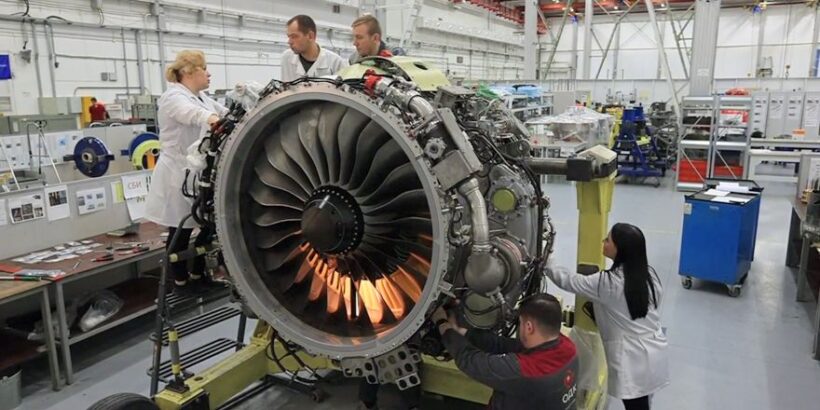
Russia’s United Engine Corporation (ODK) has completed certification testing of its PD-8 turbofan engine, the company said, marking a key step toward type certification and entry into service on next-generation Russian regional aircraft.
The PD-8 development program has accumulated more than 6,500 hours of total testing across prototype engines. According to ODK, both ground and flight test campaigns confirmed the validity of the core design solutions and the engine’s readiness for certification review.
Of the total test time, 1,449 hours were conducted in flight on the Il-76LL flying laboratory and prototype SJ-100 aircraft. The remainder was completed in ground-based campaigns covering endurance runs, performance validation, and off-nominal operating conditions.
Engineers evaluated stability across a wide envelope of failure scenarios, including bird ingestion, water and ice ingestion, and fan blade-out conditions. The PD-8 also underwent natural icing exposure tests and a series of environmental simulations intended to replicate operational degradation mechanisms.
A major milestone in the program was the final test phase conducted in April at ODK-Saturn’s open test facility in Rybinsk. During the campaign, the engine was subjected to simulated hailstorm conditions, where ice projectiles with a combined mass of approximately 220 kg were injected into the engine over 30 seconds at speeds of up to 240 m/s using a specialized launcher. The engine remained stable throughout the test sequence.
Additional icing certification work was carried out both at the Central Institute of Aviation Motors (CIAM) test facilities and during flight campaigns in the Arkhangelsk region. The engine also completed 150 hours of endurance testing replicating extended commercial operational cycles.
ODK stated that the PD-8 integrates 25 critical technologies, 17 of which were developed specifically for this program. The high-pressure turbine incorporates new heat-resistant materials and an advanced blade cooling architecture designed for elevated gas-path temperatures.
The engine architecture builds on technological elements developed for the PD-14 program, while introducing a set of design solutions tailored specifically for the smaller thrust class.
According to ODK, the high-pressure turbine includes a newly developed supersonic stage with a pressure ratio of four. Engineers also reduced radial clearances between rotating and stationary components to improve efficiency and reduce specific fuel consumption.
Following exposure to extreme operating conditions, test engines were fully disassembled for detailed inspection. Components such as turbine blades, combustor sections, and bearing assemblies were analyzed and compared against predicted wear models. ODK reported that this teardown and defect analysis process was performed more than 100 times over the course of the program, forming a key part of the certification evidence base.
ODK sales deputy director Fyodor Mironov said the engine demonstrated “high reliability and safety margins even under critical conditions.” The full certification dossier will now be submitted to Russia’s aviation regulator for review.
The PD-8 turbofan has been under development since 2019. With a rated thrust of 8,000 kgf, it is intended for use on the SJ-100 regional jet and the Be-200 amphibious aircraft. Production is based at ODK-Saturn in Rybinsk.
ODK-Saturn CEO Ilya Konukhov has previously noted that the PD-8 gas generator could also be adapted for industrial gas turbine applications in the energy and gas transport sectors.
Type certification of the engine is expected to remove a key technical barrier for full certification of the SJ-100 equipped with the new powerplant, currently targeted for August.


 (3 votes, average: 2.33 out of 5)
 Loading...