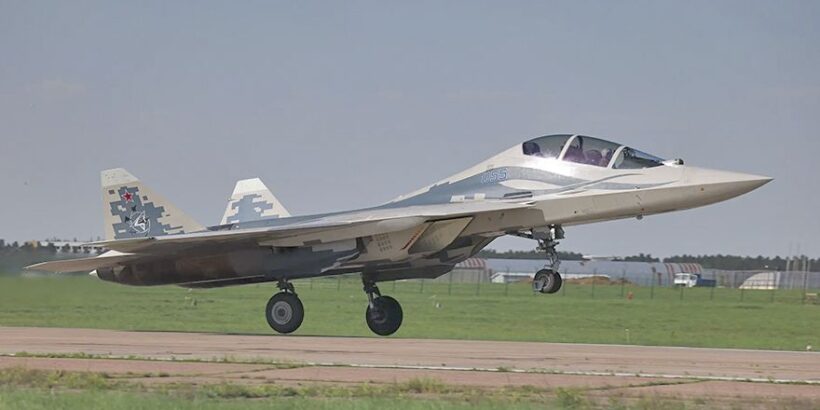
The two-seat variant of Russia’s Su-57 fifth-generation fighter conducted its maiden flight on 19 May 2026 at the Gromov Flight Research Institute airfield in Zhukovsky near Moscow, United Aircraft Corporation (UAC) said.
The aircraft, carrying side number “055,” was piloted by Sukhoi test pilot and Hero of Russia Sergey Bogdan. According to UAC, the flight was conducted in a standard configuration and focused on evaluating stability and handling characteristics across core flight regimes.
Bogdan said the aircraft remained airborne for approximately 40 minutes and that the sortie was completed without remarks. He added that the two-seat configuration showed flight characteristics broadly consistent with the single-seat Su-57, with stability and controllability matching predicted performance data and all onboard systems operating normally.
First Deputy Prime Minister Denis Manturov said the new variant will be used not only for combat missions but also as a combat trainer and airborne command platform. UAC CEO Vadim Badekha linked the development of the two-seat configuration to expanded export potential for the Su-57 family.
The prototype was converted from the single-seat T-50-5R airframe, which first flew in October 2013. After a major incident in 2014–2015, the aircraft underwent extensive repair and retained its original tail number “055.” The airframe later appeared in single-seat configuration at airshows in China and India in 2024–2025.
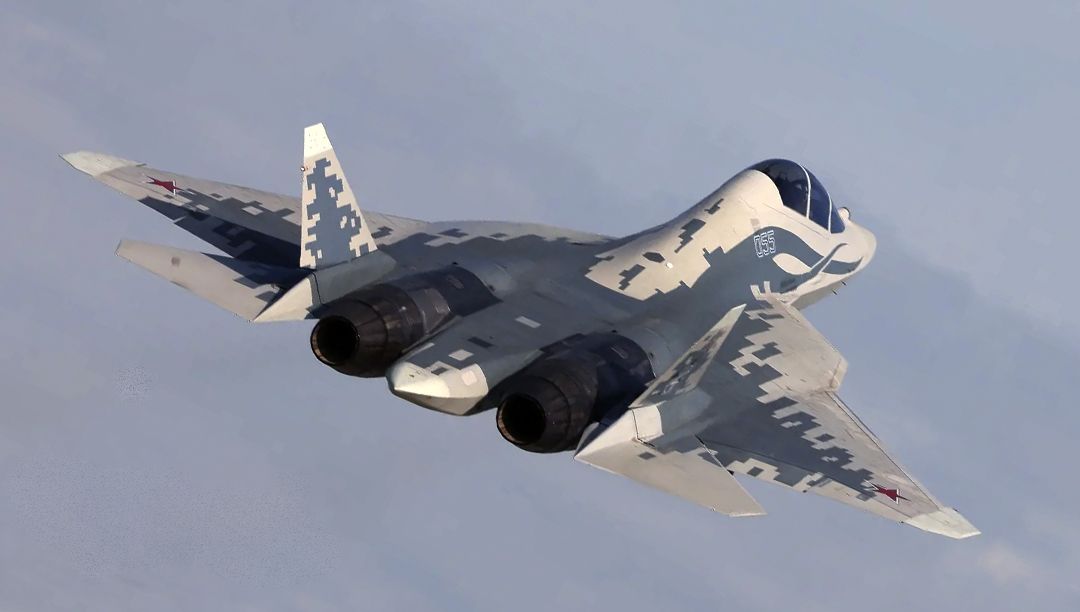
Interest in the Su-57’s operational capabilities increased following unverified reports of combat use against a Ukrainian airborne early warning aircraft. Russian Telegram channel “Operation Z: War Correspondents of the Russian Spring” claimed that on 10–11 May 2026 a Su-57 shot down a Saab 340 AEW&C aircraft supplied to Ukraine by Sweden in 2025, using a long-range R-37M missile over eastern Ukraine. The claim has not been independently confirmed by Ukrainian, Swedish, or Russian official sources.
The two-seat configuration is primarily viewed within the Russian aerospace industry as an export-oriented development. In addition to training roles, the second cockpit is expected to support expanded mission management capabilities, including coordination of unmanned systems in network-centric operations.
India is widely considered a potential lead customer for the variant, given its long-standing operation of twin-seat heavy fighters such as the Su-30MKI. For the Indian Air Force, the rear cockpit is expected to serve not only instructional functions but also support weapons management and tactical coordination roles in complex air operations.
India has traditionally required deep integration of indigenous communications, avionics, and weapons systems into imported platforms, along with local production arrangements. UAC CEO Vadim Badekha previously referenced such options at Aero India 2025. In January 2026, he said at Wings India that technical discussions between Russia and India on potential Su-57 procurement and co-production had entered an advanced consultation phase.
The official designation of the aircraft remains unfinalized. “Su-57D” is currently used as an internal working label for the two-seat configuration, while an export variant—should a localized production agreement be reached—may be assigned a separate designation.
 (1 votes, average: 5.00 out of 5)
 Loading...