Russia has completed the localization of composite materials used in the MC-21 narrowbody airliner, establishing a domestic production chain spanning from polyacrylonitrile precursor manufacturing to large integrated airframe structures.
The latest milestone came in February 2026, when Russia’s Federal Air Transport Agency approved the use of domestically produced polymer composite materials in the load-bearing sections of the aircraft’s vertical and horizontal stabilizers. The decision expanded earlier certification approvals covering the MC-21’s composite wing and PD-14 engine, granted in late 2022, and effectively finalized the replacement of foreign composite materials in key structural components of the aircraft.
Composite structures account for roughly 30-40% of the MC-21 airframe. The wing box, center wing section and high-load control surfaces represent the most structurally demanding areas. Engineers designed the aircraft around a high-aspect-ratio composite wing with a supercritical aerodynamic profile intended to reduce drag and improve fuel efficiency.
Unlike conventional aluminum structures, carbon-fiber composites maintain higher stiffness under aerodynamic loading, allowing the MC-21 wing to achieve an aspect ratio of 11.5. Comparable single-aisle aircraft with metallic wings typically remain near an aspect ratio of 10. The longer and thinner wing geometry reduces induced drag generated by wingtip vortices, particularly during cruise flight.
А. Gaidansky: Western sanctions became an incentive to create domestic composites for aviation
According to Russian industry estimates, the resulting aerodynamic and weight advantages reduce fuel consumption by up to 8% compared with other aircraft in the same class. Lower fuel burn directly affects airline operating economics on medium-haul routes while preserving comparable payload and range characteristics.
The localization effort accelerated after 2018, when Western sanctions disrupted supplies of imported aerospace composites used in the program. Earlier MC-21 prototypes relied on materials from US-based Hexcel and later from the American subsidiary of Belgium’s Solvay. Following export restrictions, the aircraft program faced delays while Russian manufacturers expanded domestic alternatives.
Carbon fibers used in the aircraft’s primary structures are produced by UMATEX, the composite materials division of Russia’s state nuclear corporation Rosatom. Current production includes UMT40, UMT45 and UMT49 fibers with tensile strengths ranging from 4.0 to 4.9 GPa and an elastic modulus of 260 GPa. Higher-modulus grades, including UMT400, UMT430 and UMT530, target applications requiring increased structural rigidity.
Russian engineers use several fabric architectures in the wing structures. Twill-weave balanced fabrics form orthogonal 0°/90° reinforcement layers, while unidirectional tapes containing more than 85% fiber alignment support heavily loaded structural members. Multiaxial ACM-series fabrics integrate pre-oriented layers at multiple angles to simplify layup of complex components.
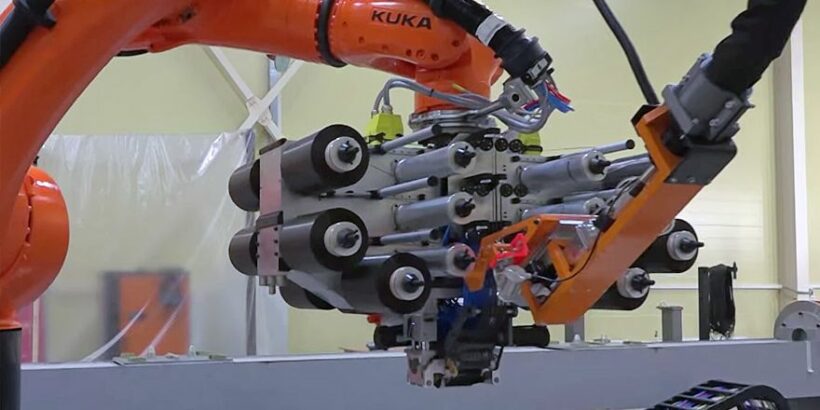
Production of the MC-21 wing box takes place at AeroComposit’s facility in Ulyanovsk using out-of-autoclave vacuum infusion technology. Dry carbon fabrics are placed into molds and sealed under vacuum before resin infusion. AeroComposit worked with multiple scientific organizations, including specialists from Moscow State University, to qualify domestically produced fibers and resin systems for the company’s manufacturing process.
Rosatom doubled the volume of carbon fibre supplies for the production of MS-21 composite structures
Russian developers state that the mechanical performance of the localized materials matches previously imported aerospace-grade composites. UMT49 fiber, rated at 4.9 GPa tensile strength, is positioned against Toray’s T700S material, while offering a higher elastic modulus — 260 GPa versus 230 GPa. Further development efforts focus on higher-performance fibers approaching the characteristics of Toray’s T800S class.
UMATEX has also developed an ultra-high-strength carbon fiber with tensile strength reaching 5.2 GPa. The manufacturing process was deployed at the company’s facility in Alabuga, where engineers also produce prepreg materials for MC-21 structural components.
| Material designation | Tensile strength, GPa | Tensile modulus, GPa | Elongation at break, % | Linear density, tex | Density, g/cm³ |
|---|---|---|---|---|---|
| UMT40-3K-EP/VE | 4,0 | 260 | 1,5 | 190 | 1,77 |
| UMT45-12K-EP/VE | 4,5 | 260 | 1,7 | 780 | 1,78 |
| UMT49-12K-EP/VE | 4,9 | 260 | 1,8 | 760 | 1,78 |
| UMT400-12K-EP | ≥ 4,2 | ≥ 400 | ≥ 1,1 | 710 | 1,82 |
| UMT55-12K-EP | 5,2 | 290 | 1,8 | 405 | 1,77 |
During structural testing at TsAGI, the domestically produced composite wing box reportedly withstood static loads equal to 150% above the design limit, maintaining structural integrity at 2.5 times the calculated operational load. The results reflected not only fiber performance, but also resin chemistry, curing parameters and laminate stacking methods.
The industrial supply chain supporting the program spans multiple facilities. UMATEX manufactures carbon fiber, woven fabrics, rovings and prepregs. At the Alabuga-Volokno plant in Tatarstan, engineers produce both PAN precursor and finished carbon fiber with annual capacity exceeding 1,400 metric tons. A separate facility in Novouralsk specializes in high-modulus fiber grades, while researchers from Moscow State University contributed to epoxy resin development.
The MC-21 composite localization program has become one of Russia’s largest attempts to establish a fully domestic aerospace materials ecosystem under sanctions pressure. The effort now covers the entire production chain, from precursor chemistry and carbon fiber manufacturing to integrated primary airframe structures.


 (6 votes, average: 3.33 out of 5)
 Loading...