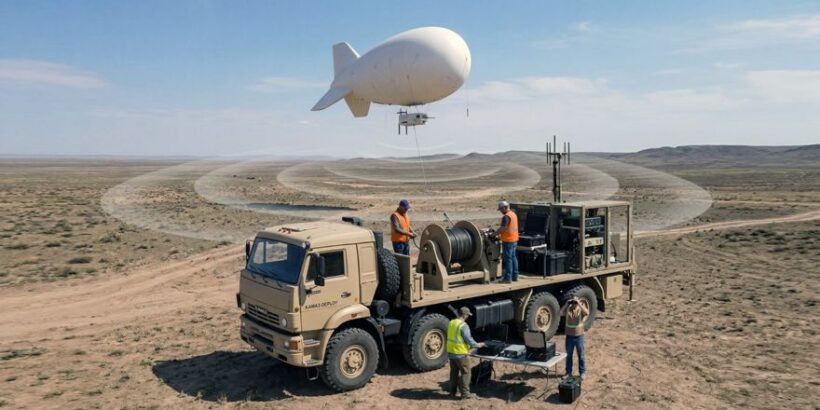
Ruselectronics (Rosel), a subsidiary of Rostec, has completed flight trials of a tethered aerostat designed for communications support. A radio module equipped with an omnidirectional antenna delivered data transmission within a radius of up to 6.2 miles (10 km) at speeds of up to 30 Mbps, Rostec reported.
The system is intended to deploy localized cellular networks in remote areas where building ground infrastructure is difficult or not economically viable, and where terrain and coverage limits constrain conventional networks. According to the developer, the solution can operate without fixed ground installations.
The prototype was tested on live communication networks with the radio module lifted to an altitude of up to 984 feet (300 meters). This elevation helps mitigate signal shadowing caused by mountainous terrain and local obstacles.
The system is configured as a tethered aerostat mounted on a vehicle-based platform. Power is supplied via a tether cable from a generator installed on the same platform. The envelope volume is 240 cubic meters, and payload capacity is up to 99 pounds (45 kg). In operational mode, the system can remain airborne for up to one month.
The aerostat-based radio system targets deployment at industrial sites, in emergency response zones, over water areas, and in locations experiencing temporary spikes in network demand, including large public events. In such scenarios, the mobile platform reduces deployment time compared with ground infrastructure, which requires tower construction and power distribution.
Aerostats belong to the class of lighter-than-air (LTA) aircraft and can maintain a fixed altitude for extended periods due to buoyant lift generated by the gas envelope. A related class includes airships—powered and steerable LTA platforms capable of controlled flight. These platforms are increasingly considered for monitoring, logistics, and airborne placement of radio and broadcast equipment.
 (No Ratings Yet)
 Loading...