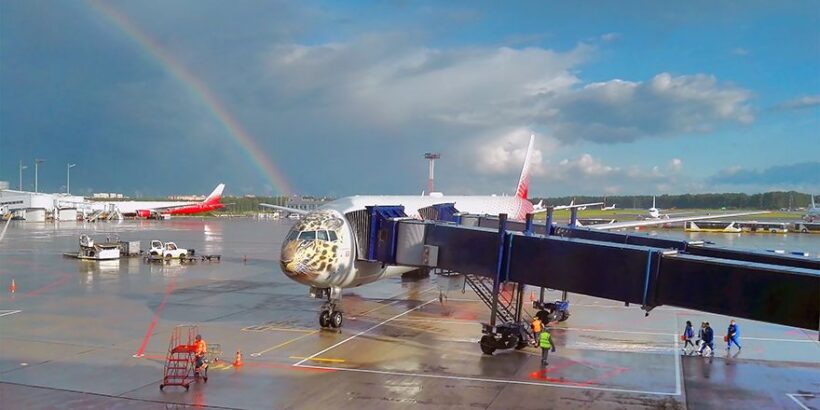
The Federal Air Transport Agency (Rosaviatsiya) released passenger traffic data for Russian civil aviation in 2025. From January to December, Russian airlines carried 108.85 million passengers. Domestic flights accounted for 81.45 million passengers, roughly 75% of total traffic, according to the agency’s report via the MAH messaging service.
Compared with 2024, total passenger traffic fell by 2.6%. In 2024, airlines carried 111.7 million passengers. The decline was driven primarily by a reduction in domestic flights, which was not offset by growth in international traffic.
International travel reached 27.4 million passengers in 2025, a 1.6% increase year-on-year, representing roughly 400,000 additional travelers. Growth was concentrated on routes outside the CIS, where passenger traffic rose 8.4% to 17.72 million. However, the expansion of international traffic remained limited and did not cover the full spectrum of overseas destinations.
In contrast, the domestic market experienced a sharper contraction. Passenger volumes declined 3.8%, from 84.7 million in 2024 to 81.45 million in 2025, a reduction of 3.25 million passengers. This decline was the primary factor in the overall decrease in total passenger traffic for the year.
The traffic structure remained largely unchanged. Domestic flights continued to represent about three-quarters of total traffic, indicating stable underlying demand despite supply constraints, particularly in terms of seating capacity on domestic routes.
Operational metrics confirm airlines’ intensive use of their fleets. Average seat occupancy rose from 89.3% to 89.5%, a 0.2 percentage-point increase compared with 2024. Higher load factors amid declining traffic volumes suggest passenger redistribution rather than an increase in total capacity. Passenger turnover reached 284.43 billion passenger-kilometers.
Total passenger traffic at Russian airports reached 214.66 million, remaining close to previous-year levels. The figure reflects steady utilization of airport infrastructure despite moderate airline traffic decline.
The five largest carriers—Aeroflot, Pobeda, S7 Airlines (Siberia), Rossiya, and Ural Airlines—collectively transported 76.57 million passengers, or 70.3% of total traffic. In the international segment, Aeroflot, Ural Airlines, and Azur Air led, while domestic traffic was dominated by Aeroflot, Pobeda, and S7 Airlines.
Rosaviatsiya characterizes 2025 results as evidence of stable performance in Russian civil aviation amid existing fleet and airspace limitations. Passenger traffic declined less than projected, while passenger turnover remained comparable to 2024. Growth in international routes outside the CIS is attributed to network expansion and changing macroeconomic conditions.
Throughout the year, airports and airlines frequently operated under temporary restrictions, requiring agile schedule adjustments and resource reallocation. Priority shifted to maintaining service quality and passenger information, including coordinated efforts among airlines, airports, and regulators.
The agency links sustained traffic volumes to stable civil aviation operations. Airport infrastructure development continued, with new terminal complexes introduced. Regular operations resumed at Gelendzhik and Krasnodar airports, and scheduled flights began to Abkhazia, Saudi Arabia, and the Philippines.
 (No Ratings Yet)
 Loading...