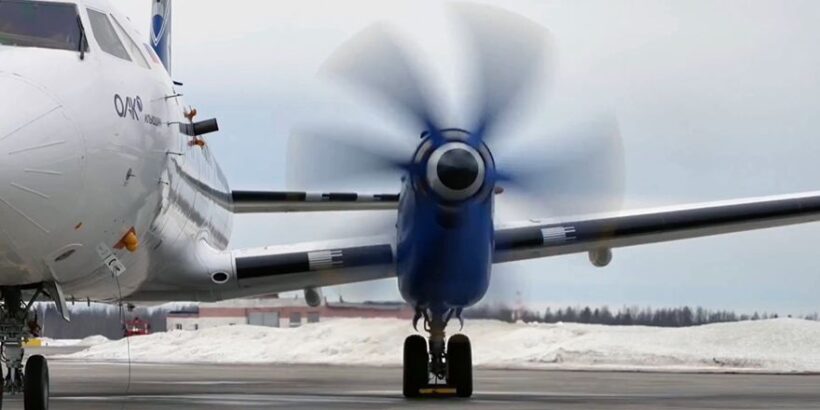
The Federal Air Transport Agency (Rosaviatsiya, Russia’s civil aviation regulator) has approved an increase in the assigned service life of critical components of the TV7-117ST-01 turboprop engine, developed by UEC-Klimov (part of United Engine Corporation), to 777 cycles. The approval follows completion of a reliability validation program for the powerplant, including the engine and the AV112-114 propeller, installed on the Il-114-300 regional aircraft, according to United Engine Corporation.
The 777-cycle rating defines the allowable accumulated operating time under repeated flight loads and represents an integrated assessment of the full mission profile. UEC defines a cycle as a composite metric that captures the full range of loads experienced by the engine during a single flight, from maximum takeoff power to approach, landing, and ground roll.
According to company specialists, this methodology treats a cycle as an integrated measure of engine wear and accounts for fatigue accumulation in primary structural components. Extending the service life increases the number of cycles before the first overhaul, directly improving operating economics. For airlines, this reduces overhaul frequency and optimizes the powerplant life cycle.
The next phase of the reliability program targets a service life of 2,000 cycles. This benchmark will guide further design maturation and expansion of operational limits during certification.
The TV7-117ST-01 engines have already completed multiple validation steps during development and certification testing. Notably, they operated as intended during a round-trip ferry flight to India in January 2026 and demonstrated stable performance under natural icing and low-temperature conditions in northern regions.
UEC views the increased service life as an interim milestone in the development program. It confirms the validity of the design solutions and marks the transition to the next phase of in-service life accumulation.


 (4 votes, average: 3.75 out of 5)
 Loading...